




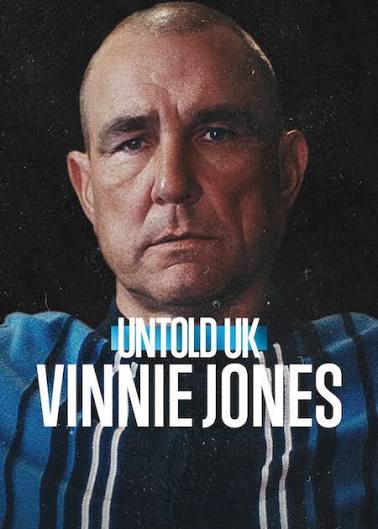
 IF you only knew Vinnie Jones through newspaper headlines in the late 1980s and early 1990s, you’d probably think he spent more time throwing punches than tackles. Netflix’s Untold: Vinnie Jones does something the tabloids rarely bothered with – it peels back the caricature and reminds us there was always far more to the man than the “football thug” label.
Jones’ story has always been one of football’s great fairy tales. A part-time hod-carrier turning out for Wealdstone one week, then making the extraordinary leap straight into the First Division with Wimbledon the next. No lengthy apprenticeship in the lower leagues, no carefully managed progression – just straight into the top flight with the Crazy Gang.
From the moment he arrived, the press scented blood. Every tackle, every booking, every off-field incident became front-page material. The football authorities seemed equally keen to make an example of him, while opposition supporters delighted in portraying him as the game’s public enemy number one. Chelsea fans, in particular, seemed convinced Jones should have been banned from football altogether every time Wimbledon came to Stamford Bridge.
Funny how football works, though.
When he eventually pulled on Chelsea’s blue shirt himself, those same supporters who once jeered him soon adored him. The same happened at Leeds United and Sheffield United. Suddenly the man who had been dismissed as nothing more than a thug became a legend – the player every fan secretly wanted in their own side.
That’s often the way with football. You hate them until they’re wearing your colours.
 Lost among all the headlines were some remarkable achievements. Jones remains the only footballer to have won both the FA Trophy and the FA Cup, collecting the medals just three years apart. Those medals have since been loaned to WiSH, preserving a unique slice of football history in SW17. Then there was his Wales debut, which attracted a sell-out crowd, proof that his appeal extended far beyond the English game.
Of course, football was only chapter one. Plenty of players disappear into obscurity after retirement. Jones somehow reinvented himself completely, carving out a hugely successful career in film and television. Today, there are probably plenty of younger people who recognise him from Hollywood before they realise he once marshalled Wimbledon’s midfield.
Watching the documentary also raises an interesting question. In the context of modern football, was Vinnie Jones really that bad? Any worse (in behaviour not ability) than Roy Keane, Robin Friday or George Best?
Yes, there were stories of fights, the infamous tale of biting a journalist’s nose, and countless moments that had disciplinary panels reaching for the rulebook. But compare that with the endless stream of sexual scandals, gambling, drug allegations and criminal investigations that seem to engulf some modern footballers, and Jones’ misdemeanours almost feel quaint. He wasn’t perfect, but neither was he the monster some tried to paint.
In truth, there was always a symbiotic relationship between Jones and the media.
Fleet Street loved selling papers with stories about football’s resident hard man, while Jones was clever enough to understand that every headline only increased his profile. It became increasingly difficult to tell who was exploiting whom. Was Vinnie feeding the beast, or was the beast creating Vinnie? The answer probably lies somewhere in the middle.
If there’s one criticism of the documentary, it’s the amount of airtime devoted to Sam Hammam. Yes, Hammam owned Wimbledon when Jones arrived and undoubtedly enjoyed basking in the reflected publicity. But this was supposed to be Vinnie’s story. Hammam’s contribution to football history has long since descended into infamy or even faded into irrelevance at best, and the time spent revisiting him could have been better used exploring other chapters of Jones’ remarkable life.

What the film does capture brilliantly is Jones’ lasting appeal. Nearly 30 years after hanging up his boots, he remains one of the most recognisable faces to emerge from English football. Plenty of players enjoyed more decorated careers, but few have maintained anything like his profile.
Here’s a simple test. Imagine Kevin Ratcliffe – holder of two League Championship medals, an FA Cup winners’ medal and a European Cup Winners’ Cup medal – walking down Oxford Street alongside Vinnie Jones. Who gets stopped first for selfies? Who attracts the crowds? You already know the answer.
Legacy isn’t always measured in medals.
Ultimately, Untold: Vinnie Jones succeeds because it reveals the person behind the persona. Beneath the snarling hard man was someone intelligent enough to reinvent himself, fiercely loyal to his clubs, his teammates and, above all, his family. The documentary doesn’t ask you to excuse everything he ever did, nor should it. Instead, it asks you to understand how the legend was built.
Nearly three decades after his final whistle, Vinnie Jones still has that aura. Still relevant. Still recognisable. Still impossible to ignore.
Some legends are remembered because they won everything. Others are remembered because they walked onto the pitch. Vinnie Jones belongs firmly in the second category.