Wimbledon will share Plough Lane with the London Broncos rugby league club after a majority vote of Dons Trust members at a virtually-staged SGM.
The Dons Trust Board unanimously recommended that a ground share take place with the Broncos and a 91% majority among more than 500 votes at the March 31 meeting backed the move, meaning the Broncos will play their home games at Plough Lane, likely later in their current Championship season.
The ground share will net the Dons around 200K pounds a season in stadium rental along with a share of drinks and food sold at the games.
Planning permission has been submitted to stage rugby league games at Plough Lane but that will only take place after Dons fans can attend test events inside the ground – the first one on May 18 for up to 2,000 fans.
There will be other test events involving Wimbledon fans before the London Broncos will be able to stage their home games at the stadium. In the meantime, the Broncos will play their games out of Ealing.
Following the Dons Trust Vote this week we would like to thank all of those who voted in favour of the Broncos playing at Plough Lane.
The tier two league, which began in April, runs until the final home game on September 12 so there is minimal overlapping of seasons with Wimbledon, while the Plough Lane groundsman has confirmed there will be little damaging impact on the immaculate playing surface with rugby league as opposed to the scrum-churning rugby union.
The reason for the club’s appetite to host the London Broncos is financial. The Dons Trust have considerable debts to repay for the completion of Plough Lane along with debentures and short-term loans to repay and a steady stream of income from the groundshare will help ameliorate the financial burden.
If the London Broncos do get promoted to the tier one Super League then the ground rental will rise with expected larger gates from the bigger and well-supported rugby league clubs.
London Broncos fan Jake Rainbow wrote recently in the Wombles Downunder fanzine: “I can entirely understand and support the desire of AFC Wimbledon fans to be the first fans to turn out in the new home you have been hoping for so such a long time.
“I know this view is shared by every London Broncos fan I have spoken to or seen discussing it online, and we would not want to be the ones to stand in the way of that.
“I hope, and truly believe, that the Broncos and the Dons can have a solid partnership going forward, beneficial for both sides.”
This continues a number of ground shares the London Broncos have had with other football clubs in London.
The Broncos ground-shared at Craven Cottage (Fulham) until 1991, then The Valley (Charlton) for the 1996, 2000 and 2001 seasons, Griffin Park (Brentford) between 2002 and 2006 and The Hive (Barnet) for 2014 and 2015.
AFC Wimbledon are looking for a ‘cultural change” with the in-house appointment of Mark Robinson as the new ‘head coach’ to replace Glyn Hodges.
The announcement has been welcomed by a groundswell of approval from the fans, who like the club hierarchy, have been impressed by the thorough manner in which ‘Robbo’ has handled things in his two games in charge as interim manager.
Robbo, who first came to the club a volunteer coach of the Under 9s in 2004, has been instrumental in the outstanding success of the club’s academy from where he has developed Will Nightingale, Anthony Hartigan, Jack Rudoni, Paul Osew and Paul Kalambayi among others into first-team players.
After the churn of three club legends Neal Ardley, Wally Downes and Glyn Hodges as club manager in the space of 27 months, the club saw a need to effect change in the way it wanted to go forward. Mark Robinson is the one the hierarchy see to bring that about.
“In his short time as Interim Manager, Mark has made a hugely positive impression on the players and staff,” club chief executive Joe Palmer said at the announcement.
“This impact, coupled with his determination and ability to bring about cultural change, gave Mark the edge over the other candidates and we are delighted to give him this chance to show us where he can take us.”
Robbo’s first task is to keep AFC Wimbledon in League One, but he is being given the scope and support to change the way things have been done as the Dons have struggled to be a viable Tier Three team.
Evening, thank you all for your support it's genuinely overwhelming. "If you want to walk fast walk alone if you want to walk far walk together" COYDs
Robbo is passionate about getting the best of the club and its squad of players.
“Everyone knows how I feel about AFC Wimbledon and I am absolutely thrilled to be given this opportunity at the club that is the greatest story in football; a club with a great heritage and the best supporters in the country,” he said.
“There is undoubtedly a lot of hard work to be done but when you look at the quality in the squad and the academy, alongside the good people we have in place in and around the club, if we can all pull together it makes me genuinely excited about what we can achieve.”
High on his priorities is to change the way player recruitment is done at the club.
Robbo – "Personally, I don't think our recruitment policy was the right way. I'm a coach, I'm a builder of cultures and environments, so I don't want to be on my phone dealing with agents, I don't think that should be the way forward… 1/3
… "And then we need a recruitment policy where I get three or four players to choose from and we need a proper character profiling system, that's where you know you get the right player and the right kind of character to come into our squad." 3/3 @9yrspodcast
Robbo has contenders in mind for the assistant manager role as he looks to reshape Wimbledon in his image.
Robbo has three options for the assistant manager. Two of them are still in work and the other came up during the interview process. Decision likely next week. @9yrspodcast
There is plenty of admiration for the way Robbo goes about building a team environment. He avidly looks at ways other coaches – like Australian Eddie Jones in charge of the England rugby team – work to get the best out of their players.
2/2: mentor, innovator, leader, coach and now add ‘First Team Head Coach’ to that long list. One thing that won’t be doubted is you won’t find anyone with more passion, enthusiasm & love for the club. I won’t say good luck to him, because he doesn’t need it 🔥⚽️ @AFCWimbledonpic.twitter.com/hDN4HW6Qsz
Some nice words from former players tell you a lot about the esteem that @MarkRob63506369 is held in. Good luck Robbo. I know no-one will work more diligently than you in the top job. pic.twitter.com/bW765yO2iV
Concerns? Well, Robbo has no managerial experience at Football League level and would have scant contact with other Football League clubs to bring players in.
That may be addressed by restructuring the recruitment process, whether someone with experience is employed by the club to fill that role and leave Robbo to do what he does best.
Robbo would also need a No.2 capable of addressing the issues he as head coach is not suited to. A reverse of the usual manager-assistant axiom “You fix the pitch. I’ll fix everything else.”
It is an appointment not without some risk given Wimbledon’s precarious position in the relegation zone with 20 games left in the season.
But on the other hand, Robbo just might be the catalyst of giving Wimbledon a cultural change, an identity, it seeks and capitalising on the steady stream of home-produced starlets into the first team. Robbo knows the situation inside the club better than most.
It is a tantalising prospect that has the ardent support of much of the fan base. Heroic, possibly, but not without the possibility of leading Wimbledon into a new exciting era. The next months will be fascinating to see which way the pendulum swings.
IT took 10,776 days – 29.5 years — for Wimbledon to play again in Wimbledon. It was an odyssey, it was fraught with obstacles to overcome along the way but the fans-owned club triumphed in the end. PETER LENG tracks the long and winding road to Plough Lane.
The return to Plough Lane, after nearly 30 years in exile, is the story of a community that wouldn’t take no for an answer, that wouldn’t allow itself to be beaten into submission or even non-existence, that wouldn’t give up hope. It is the story of ordinary fans standing up for their belief in having a local football club to support, fighting the fickle power of money and a remote football establishment, plotting a newfuture away from wearingly uncertain and long years as nomads to owning our own football club in a permanent home back in Wimbledon. Getting back to Plough Lane is perhaps the defining chapter in the story that proves that AFC Wimbledon, set up in defiance of the football authorities, was and continues to be very much the antithesis to the FA’s damning “not in the wider interests of football” slur. In 2011 the winning back of our league place was the righting of a historic wrong; in 2020 returning to our spiritual home in Plough Lane is, as one newspaper put it, the end of an odyssey. It is the club returning to its rightful place in and with its local community.
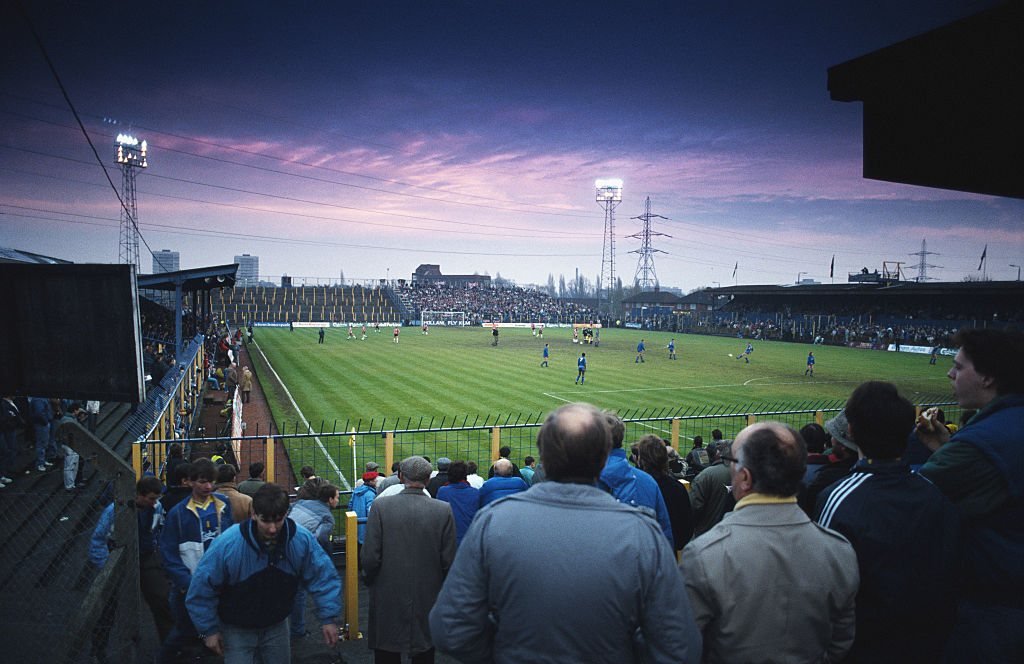
Old Plough Lane – Getty Images
The story starts at the final whistle in Plough Lane on May 4 1991, when Wimbledon FC was playing Crystal Palace in the ground it had called home since 1912. At the time few among the home support in the 10,060 crowd could really have believed that it would be the final home game in Plough Lane. The Dons were a club which had and would continue to punch above its weight for many years; that penultimate season of the old First Division finished with the Dons in seventh place, a lofty slot which defied the ramshackle ground which had been home to the club’s astonishing rise from its pre-1977 non-league days.
The pressure to move was all the greater because of the 1990 Taylor Report which had demanded all-seater stadiums by 1994 in light of the 1989 Hillsborough disaster. Club owner Sam Hammam determined that the small Plough Lane ground could not be transformed in to the required all-seater stadium that would be fit for purpose in the new, impending Premiership era. And so it was goodbye – without having properly said goodbye – as Wimbledon’s beloved stadium was sold to property developers and we were banished to ground share with Crystal Palace in their corner of southeast London.
The 1990s were the years of exile in Selhurst Park. What was supposed to be a “temporary” ground share was to end up lasting for more than a decade. There was much talk of plans to build a new stadium back in Merton, of a site in Beddington, but they never materialised whether because of politics or money. So Selhurst Park it was.
But the seeds of the fightback were germinating. A refusal to accept being a diaspora was setting in. In 1997 the Wimbledon Independent Supporters Association launched its campaign “It’s Time We Had a Home Game”. The Dons Trust was set up by fans in February 2002 to fight moves to relocate the club, with fans deciding themselves to be front and centre in the running and future of a Wimbledon football team. But it all seemed to have been to no avail when our world came crashing down on May 28 2002, with the heart-breaking decision by the Football Association’s three-man commission to allow the club’s owners to move Wimbledon FC 60 miles away to Buckinghamshire. Many of us fans have not been so devastated, before or since. These were the end days it seemed, the point of no return. But again, we Wimbledon fans refused to bow, led by a number of determined diehards who had the energy and optimism to regroup. The MK move was the red line, the move that kick-started the reinvigoration of the Wimbledon FC fan base into the revamped AFC Wimbledon.
Forward wind nine years, five promotions later, and we were back in the Football League. Our home for this extraordinary time of growth and success was Kingsmeadow, home to Kingstonian FC – similar to Plough Lane in its non-league size and features. But it still did not feel like home. Although we bought the leasehold for the ground and eventually gifted Kingstonian £1million to ensure we were not seen as asset-grabbing big-footers, it always felt like it was not the forever home. That, we knew was back in our historical home of Plough Lane.
Kingsmeadow
Once our league status was won back in 2011, and the first goal of our fightback against that betrayal of 2002 was achieved, attention turned to addressing the finding of a way back to our real home. One of the founding fathers of AFC Wimbledon, Ivor Heller, summed up the determination which had never gone away: “From the very start we talked about it. There was just an irresistible pull – there is something in the Wimbledon DNA”. The club launched its bid to return to Plough Lane in 2012, but it took over two years before we could submit a planning application. Heller again: “The big turning point was when councillor Stephen Alambritis became leader of Merton Council. He was the guy that plotted the route for us more than anybody else.”
Where the 1990s were the miserable years of exile, the 2000s were the exciting years of rebirth and growth, the years 2013-20 were the nail-biting years of plotting and planning our Plough Lane return.
In 2013, AFC Wimbledon announced that talks were underway with Merton Council over a joint bid for the Greyhound stadium and surrounding land in the SW17 end of Plough Lane, some 200 metres away from our old ground on the other side of the river Wandle. This bid was submitted in cooperation with Galliard Homes to build a new football stadium, 600 residential units and a wide range of shops and community facilities. The site had been designated for “sporting intensification” by Merton Council, so our hopes were high. The dog track was a run-down site, an eye-sore which did little to benefit the local community. The club had signalled its way forward, and fans were soon on board. A “Bring the Dons Home” campaign was launched at the beginning of December 2013. The club was working hard behind the scenes to push its plan to bring football back to Plough Lane; we fans were encouraged to do our bit in a “Write Now” campaign – putting pen to paper again to Merton Council and others to argue our case for a community-based football stadium in Merton. So began years of intense lobbying to help realise our long-term dream.
Wimbledon Greyhound Stadium
Fans of greyhound racing launched their own counter “We Want Wimbledon” campaign, arguing hard with local residents, politicians and councils that the greyhound stadium should remain. A competing plan was put forward by businessman Paschal Taggart who wanted to build a 4,500 capacity stadium on the site to be a world-class dog track. The war of words was fought out in the press and leaflets circulated in homes around Plough Lane. The Dons campaign was passionate but measured, setting out the benefits of a new stadium which would serve the local community as well as fans of football.
Then on 10 December 2015, after a two years of frayed nerves and hard campaigning, Merton Council’s planning committee made the decision which at last gave the green light to our stadium plans. Our proposal for a new football stadium, with a housing development on land adjacent to the ground, received the thumbs up. We were good to go. We had sold Kingsmeadow stadium to Chelsea in 2015, and with the proceeds from that and the funds from the housing development, we now had the planning permission to build our dream.
And then the obstacles appeared. The anxiety had returned as supporters of the dog track refused at the end of 2015 to accept the Merton planning decision. They had sympathetic ears and heard supportive noises from local residents groups and from neighbouring Wandsworth Council which worried about the impact of a new football stadium and housing development on local services and transport. After Merton Council’s approval for the plans in December 2015, the planning spokeswoman at Wandsworth Council, Councillor Sarah McDermott, called on the Mayor of London to “intervene and scrutinise this application much more comprehensively”.
We entered 2016 with the rumblings of Wandsworth Council’s and greyhound fans’ discontent were heard in City Hall, and the first signs of trouble for us came in February 2016 when the then Mayor of London, Boris Johnson, expressed concerns about our stadium plans, highlighting, in particular, issues with affordable housing, flood risks and transport. Another dark day of sinking hearts arrived for us Dons fans on 23 March 2016, when the Mayor called in the Plough Lane stadium application for further consultations. What did Johnson mean when saying he was “calling in” the application? In effect the Mayor would act as the local planning authority and begin the consultation process again before a final decision would be made.
We were seemingly back to square one in the planning process. And with a mayoral election on May 5 it was unlikely the process would begin until July, at which point it would be taken over by a new Mayor. It seemed Johnson was stalling. Merton Council was perplexed, its council leader Stephen Alambritis calling Johnson’s decision “very, very disappointing…very poor on his part to hand the decision to a new mayor”. Nobody knew why Johnson did this, given the unanimous decision by Merton’s planning committee, the response to the consultations and his own Greater London Assembly officers asking him to approve it. But Wimbledon and its fans never gave up hope. Chief executive, Erik Samuelson, led the way, saying he was very disappointed by the Mayor’s decision but not surprised: “We will represent our case strongly and clearly, and I still think it’s an overwhelmingly positive case”. And that positivity and continued lobbying by Dons officials and fans paid dividends when on 23 August 2016, the new Mayor, Sadiq Khan, handed the decision back to Merton Council. It was another day of huge relief and joy for us Dons fans.
Show Me The Way to Plough Lane
Khan’s U-turn angered Wandsworth council, which claimed the new stadium would put huge pressure on the area’s transport network with increased traffic congestion and more passengers accessing local rail services.
Wandsworth’s concerns clearly hit a nerve, because our planning permission for the new football stadium now entered another period of prolonged debate – largely conducted by club and council officials behind the scenes. This was the age of the S106. An S106, in a nutshell, involves extra planning obligations. Section 106 is part of the 1990 Town and Country Planning Act, a mechanism or agreement between the local authority and the developer, which makes a development proposal acceptable in planning terms that would not otherwise be acceptable.
And bingo, on 13 December 2017 our own S106 was formally signed and planning permission was finally cleared by Merton Council. It was, said Alambritis, “a historic moment”. Under the S106, AFCW and the developers (GRA Acquisitions Ltd) committed to not only bringing major new development and the associated economic benefits to south west London. They would also pump in £1.5m into local health provision and improvements to the local bus, road and cycle network. Samuelson waxed lyrical: “A group of fans started with nothing: no ground, no team, no manager, no players and no kit. Now fifteen years later, we’ve taken a giant step towards going home to Merton, in a new stadium and as a Football League club. This is a momentous day for us”.
“Great!” we all thought, the S106 now provides authorisation for the stadium construction and we were good to go – but again, no! Our planning education had another lesson for us fans to learn: yet another potential legal obstacle had to be cleared. Having overcome all the Council planning application hurdles, we now faced a six-week period during which an application for a judicial review could be launched. But to our huge relief again, the delay did not happen. The final legal barrier failed to materialise and the way was clear for demolition of the greyhound track to begin. On 16 March 2018, clearance began of the Plough Lane site in preparation for the new football stadium and housing development. The bulldozers moved in, and I wandered down there frequently to see the old dog track disappear and the rubble taken away to leave a large clear site for our new home and the blocks of apartments around it. The year ended with the land’s freehold transferred to an AFC Wimbledon subsidiary on 24 December 2018.
The summer of 2019 had been billed as the target time for the new stadium to open and for football to resume on the site for the first time since 1991. But delays in our planning process had pushed this back, probably to 2020. Of course, this story would not be the one it is if it did not have yet another worrying twist. The storm clouds at the end of 2019 were in the form of finance. It came as something of a bolt out of the blue when Dons fans were told at a Dons Trust meeting in November 2019 that there was a £11million shortfall on the building budget due mainly to delays in the planning process and lengthy talks over commercial agreements. Unless this shortfall could be met, the builders, Buckingham, would have to stop work in the following January (2020). The news came at the worst possible time with Brexit looming and the uncertainty of a general election, and with banks nervous of lending to football clubs given the parlous nature of many lower league football clubs.
But as ever, it is in these times of adversity and obstacles that Dons fans rose to the challenge of finding ways forward. Spiralling building costs had already seen fans dip in to raise £2.4million in a Seedrs crowdfunding initiative. The mood music from some in the Dons Trust seemed to be that fans had already contributed as much as they could to the Seedrs initiative, so it was now time to consider outside investment in the club to try to plug the £11m gap; there were three local businessmen, we were told, who would put in £2.5m each and so help get us close to the target we needed.
Just as we were on the verge of getting home, we were once again embroiled in an existential debate about what AFC Wimbledon is. We have always been a fan-owned club, but was now the time to open the door to external investors who may not be fans and have the club’s footballing interests at heart? It resurrected a debate which perhaps was bubbling under the surface, but which heated up to the point that a small group of fans with suitable financial expertise – determined to save the fan-owned model of the club – suggested the issuing of a bond to secure the necessary funding to complete the construction of the stadium. And so the Plough Lane Bond was issued, investment in the club in the form of loans of a minimum of £1000 on five, ten and 20 year terms, at rates of interest up to 4% to be chosen by the investor. It was another creative and constructive effort by fans themselves to do their bit to ensure that Wimbledon could once again play football in Plough Lane – and to remain a fan-owned club.
The bond raised an astonishing £5.4m and did ensure that the builders could continue their work and keep our dream alive at that crucial juncture. On May 28 this year, local businessman Nick Robertson did invest another £2.5m – a crucial cash injection which allowed the club to sign all construction contracts and go to the banks to secure a vital short term bridging loan for the last £4m of the shortfall.
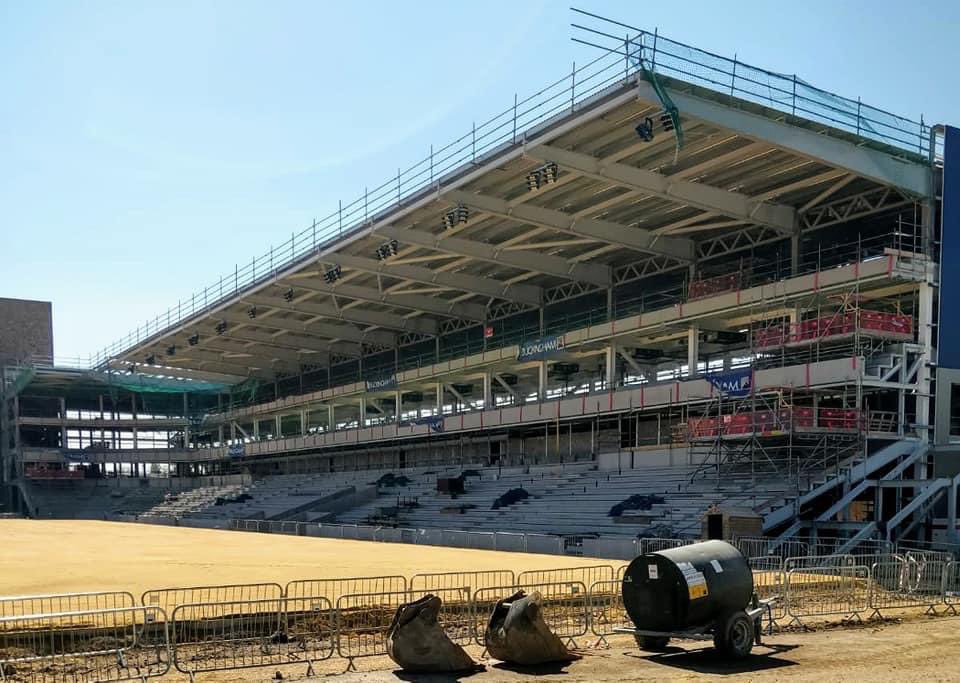
Plough Lane stadium under construction
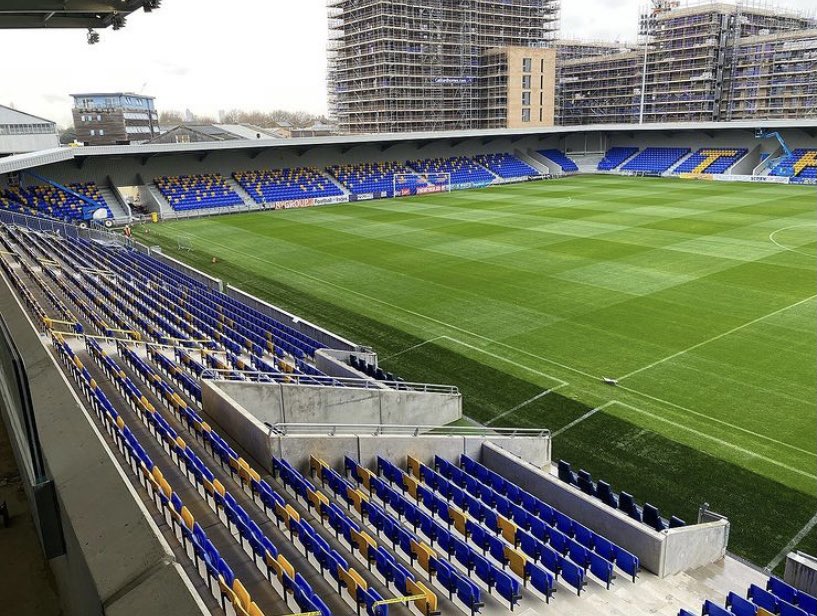
Throughout late 2019 and 2020 building itself continued. Over the summer, living not far from the stadium, I walked by almost weekly to check on the development – seeing the stands rise up and the speckled yellow and blue seats being installed, then the floodlights go up….it was a summer of unremitting happiness for me as I watched our new home take shape.
Our new home can hold 9,300 fans, but allows us to grow and find our natural level with the option and possibility of it being expanded to accommodate 20,000. It will have state-of-the-art facilities, including the largest conference centre in Merton, to provide commercial opportunities for the growth. There will be an on-site pub which will open seven days a week. It will hark back to our original home with the name of the pub likely to be The Batsford Arms, the name of choice among most fans. A museum too will marry the old and the new, with paraphernalia and memorabilia on display from our old ground just down the road.
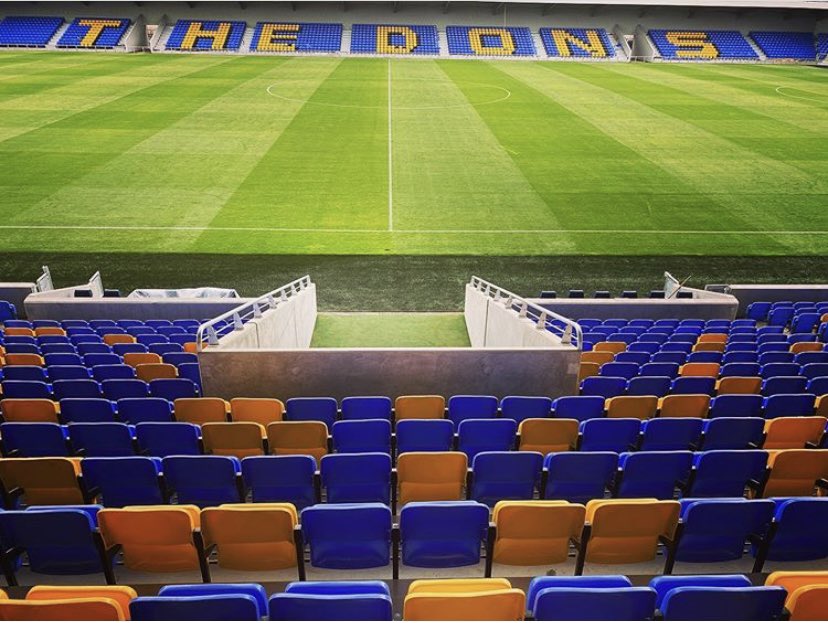
The pitch view from our season ticket seats
In August came the long-awaited moment to choose our individual seats in our new stadium. Launching a new ticketing and debenture scheme was an ambitious project, after years of watching games from behind the goal in the John Green stand at Kingsmeadow, a viewpoint from the halfway line appealed. With my son and daughter and close friend we got four seats in the second row right above the players tunnel, half way up and smack on the halfway line. I’ve seen the seats and the view from them in those amazing pictures on social media, and am happy beyond words to know that we will have them as debenture holders for the next ten (or eleven) years.
And so we come to the final chapter of this incredible story, a chapter with the magical date of 3 November 2020. This was to be the day of our first game back in Plough Lane, football played back in Wimbledon for the first time in 10,776 days – a 29.5 year wait. Wimbledon playing again in Wimbledon.
But it was a bittersweet day. Happiness that our football team was home at last was tinged with a visceral sadness, disappointment that we fans could not be there in person to share this amazing moment. Curse you Covid. As the local Wimbledon Guardian summed it up: “A story involving protest, injustice, homelessness, despair, revival, promotion, financial worries and persistence finally ends amid a global pandemic”.
Until we can be physically in there cheering on our team, we are not properly home. We still wait to enter the promised land too.
As Vinnie Jones, memorably once said: “it’s been emotional”. After nearly three decades in the wilderness, we are back home and masters of our destiny. The future is ours to shape as we will. We can all now sing together our post-1991 battle-cry and anthem: “The Wombles had a dream, To watch our football team, Playing back at Plough Lane, Where we belong, The journey was long, The FA were wrong, We’re AFC Wimbledon — We brought the Dons home”.
Plough Lane 2020
[The Long and Winding Road Back to Plough Lane was first published in the November-December 2020 issue of the Wombles Downunder fanzine. Details on how you can subscribe to Wombles Downunder.]
[Ed: This is an abridged version of the original article.]
Kingsmeadow provided AFC Wimbledon with the refuge and succour in the fledgling club’s hour of greatest need. Yes, it can be a bit of a dump. But it’s been the dump that has given us a home for the past 18 years and that has chaperoned AFC Wimbledon on its considerable journey from the Combined Counties League to League One. IAIN SANDFORD bades a fond farewell.
I have a particularly fond ‘Kingsmeadow moment’ that endures repetition two to three times per season. It occurs immediately following the game on that narrow stretch of pavement on the Kingston Road between where the visiting supporters exit the away section and head towards the coaches that will transport them back to whence they came.
In this moment, the visiting fans will have just seen their team end up on the wrong end of a classic Dons smash and grab. This will have been either a late winner or equaliser scored against the run of play (think Portsmouth and Lincoln last season) or just a plain, old-fashioned injustice (think Peterborough in January this year… and try to stop chuckling!). Coming face to face with the Dons faithful, their faces etched in post-match angst and frustration. There are moans aplenty – mainly about the game and score-line but also about the poverty of the view and facilities the away fans have had to put up with. As the home and visiting fans brush past each other, one can overhear snippets of a post-match analysis: “Can’t believe we didn’t thrash them. We should have scored four or five”, followed by a cranking up of the churlish: “What a dump, an absolute dump. Couldn’t see a damned thing.”
Personally, I love this kind of feedback. It demonstrates that the match day experience for visiting teams has been uncomfortable, sufficiently so to affect those margins that can determine the outcome of a game. In any given season, this could conceivably yield us an additional five to ten points – which in the past three seasons has been the difference between us staying up and being relegated. While we’re rightly salivating about our imminent return home, let us not forget that first and foremost we are a football club, currently punching considerably above our weight.
Walking up Jack Goodchild Way every couple of weeks regularly reminds us of this, of keeping our feet on the ground. Important though they are, let’s not get too obsessed with talk of income streams, corporate hospitality and debenture schemes.
Yes, Kingsmeadow is a bit of a dump. But it’s been the dump that has given us a home for the past 18 years and that has chaperoned us on our considerable journey from the Combined Counties League to our present perch, clinging on for dear life in League One. It has a creaking, homespun charm that has served us well. Kingsmeadow as a stadium and a football ground has evolved. Let’s not forget that less than ten years ago, what is now the John Green Stand used to be a wholly inadequate, non-sloping terrace with a view of the action even more challenged than what is now the RyGas stand. And the quality of the playing surface, thanks to the stewardship by Chelsea Ladies, is now light years away from the churned-up cabbage patch of the early-mid Kingsmeadow years.
The major downside for Kingsmeadow is of course its location – and there ain’t a lot we could have done about that. The very existence of Norbiton is as convincing an argument as there is against the tenets of Intelligent Design. It’s as weird as Milton Keynes but carries more of a dystopian menace. No, I don’t think anyone will miss Norbiton.
I started following Wimbledon FC regularly in the late 1980s and the prospect of returning home is an enticing, romantic prospect and one that will hopefully propel us to the next level in terms of community involvement off the pitch and footballing success on the pitch. But even though it is unlikely I will ever visit the place again, I will never forget the refuge and succour that Kingsmeadow has given us in our hour of greatest need.
Below are thumbnails of my top 10 ‘Kingsmeadow moments’, recorded chronologically. They are a fairly random, not exhaustive selection which I hope, in some way, depict the eclectic, unpredictable, high achieving football club AFC Wimbledon has been in its now ex-home, Kingsmeadow.
AFC Wimbledon 3 Hartley Wintney 1, 31st August 2002, Sim Johnston, top corner screamer
Controlling a difficult bouncing ball on his instep and then adjusting his body shape, Johnston fairly lashed the ball into the net from approximately 30 yards with power and dip. If this had been Stevie G, it would have been feted and replayed ad infinitum. Two weeks into AFC Wimbledon’s debut season and I remain convinced that I will never, ever see a more perfect Dons goal – and yes, Sim was a centre-half!
Kevin Cooper goalscoring exploits, 2002-04
Possibly the most astute business we ever made was to sign up the natural goalscorer who impressed in AFC Wimbledon’s first-ever game on that balmy evening in Sutton. Never mind the mind-numbing quantity (107 in 106 appearances), admire the quality of many of them. Almost De Bruyne-esque in the clean and precise way he struck the ball, Cooper rightfully has legendary status in the history of AFC Wimbledon.
AFC Wimbledon 1 Harrow Borough 2, 1st September 2007, Adomah volley from half-way line
Having missed the majority of games under Dave Anderson (but not the dispiriting play-off semi-final defeat against Bromley which hastened his departure), I was keen to get back into the swing of things with the exciting appointment of Terry Brown. A drab game lit up by a wonderful piece of skill by Harrow’s young forward Albert Adomah who, on receiving the ball, flicked it up, swivelled and struck a majestic volley over a bewildered Andy Little from the half-way line.
AFC Wimbledon 3 AFC Hornchurch 1, 29th April 2008, Rymans Premier play-off semi-final, Main slalom goal
Having fallen tantalisingly close in the previous two campaigns, there was no margin for error for manager Terry Brown who, earlier in the season had rolled the dice and recruited Jon Main, the division’s most prolific striker from Tonbridge Angels, to provide that extra push to get the Dons over the promotion line. It was 2-1 in the play-off semi-final with injury time approaching and the tension was palpable. Not that this affected Main, who picked the ball up on the half-way line and embarked on a slalom run that left two Hornchurch defenders and the goalkeeper on their backsides before slotting the ball calmly home.
AFC Wimbledon 6 Fleetwood Town 1, 11th May 2011, Mohammed hat-trick in drubbing
The Dons were ruthless in their dispatch of the great pretenders Fleetwood Town, following the 2-0 away first-leg triumph with an emphatic 6-1 drubbing in the home leg five days later. It was the perfect night for new recruit from Bath City, Kaid Mohammed, who effectively put the tie to bed by scoring within the first 30 seconds. Mohammed’s power, running and finishing was a thorn in the side of the Fleetwood defence, whose physiques looked as though they had done their pre-match training in the local Wetherspoons.
AFC Wimbledon 0 Barnet 1, 1st April 2013, Barnet’s central midfielder
Who is that geezer with the dreadlocks and the shades who looks as though he can play a bit? Why it’s multi-award winning ex-Ajax, Juventus, Barcelona and Inter Milan midfielder Edgar Davids – now, bizarrely player-manager for Barnet and inspiring his team to a late win over the hapless and increasingly relegation threatened Dons. Surreal.
AFC Wimbledon 2 Fleetwood Town 1, 27th April 2013, Midson survival penalty
Everyone knows the narrative. Win and we stay up. Draw or lose and we are relegated back to non-league football. The stakes couldn’t be higher. There are 18 minutes remaining and the score is 1-1 when Dons’ right-back Curtis Osano finds an ingenious way of locating a Fleetwood leg, makes contact and wins penalty. Many refs wouldn’t have given it. Thankfully this one did, leaving the coolest man in the gaff, Jack Midson, to slot home the penalty and preserve our Football League status.
AFC Wimbledon 1 Charlton Athletic 0, 10th April 2018, Lyle Taylor complete performance
A midweek game at Kingsmeadow, under the lights and a crackling atmosphere. From the outset, it was clear that the Dons’ soon-to-be departing talisman Lyle Taylor was up for it. Hustling and harrying the Charlton defence throughout the 90 minutes, Lyle delivered the complete centre-forward performance, including pressing Charlton centre-back Patrick Bauer into a costly error, leaving Taylor with a one-on-one with the Charlton goalkeeper which he gleefully converted to win us the game.
AFC Wimbledon 4 West Ham United 2, 26th January 2019, Wagstaff delivers
This Saturday night drubbing seems like yesterday as plucky, bottom-of-the-table Dons chastened the East End Premier League wideboys to a humiliating, ignominious FA Cup defeat. This was the game when Scott Wagstaff stepped out of the shadows to prove there was more to his game than running around a lot. Waggy’s reward for his dynamic display was a date with chirpy BBC reporter Mark Clemitt, a yellow and blue dyed beard and demotion to the substitute’s bench for the next round vs Millwall.
AFC Wimbledon 2 Wycombe Wanderers 1, 27th April 2019, Pigott cements ‘Great Escape’
Four days earlier the Dons were celebrating as if we had won the UEFA Champions League, Premier League and FA Cup, all on the same night. We hadn’t – we had drawn 2-2 against League 1 champions elect Luton Town, albeit in a season changing manner. Fortunately, everyone had calmed down by Saturday, not least the players who were aware that there was still a job to do, starting with a tricky encounter against a niggly Wycombe Wanderers side. Step forward Joe Pigott who put behind him the disappointment of an early penalty miss with two opportunistic headers to cement the most unlikely of ‘Great Escapes’.
So farewell then Kingsmeadow – it’s been emotional!
[Farewell Kingsmeadow was first published in the May-June-July 2020 issue of the Wombles Downunder fanzine. Details on how you can subscribe to Wombles Downunder.]
Faced with the prospect of losing club control to outside interests, Dons and other fans rallied behind the Plough Lane Bond. In a short time a staggering £5 million-plus was raised. WDSA talk to two of the PLB instigators Xav Wiggins and Damian Woodward about how it all came about and looking forward to the new stadium.
i) Did you and others go to the Dons Trust SGM on December 9 with the plan of a Plough Lane Bond given that one of the options the DT Chair was pushing at the meeting was that outside investment was the only realistic solution to raise money for the shock £11 million funding shortfall for the stadium construction? Where did the idea for the Bond emanate?
Damian: I don’t think there is a really clear answer. We knew that a lot of fundraising talent within the fan base had largely been ignored for one reason or another and that there were latent concerns around the skill set on the DTB to really understand the dynamics of this kind of process. When it surfaced that there was a major issue, as ever the ideas started floating quite quickly about things we could do ourselves and what the club could still do itself in terms of formal external debt. We knew there was money left in the fan base post SEEDRS, and the idea of loaning more to the club felt like an obvious route to investigate. We were clear at the SGM we were going to raise the clear concerns that not all routes had been properly investigated and the bond suggestion was simply the label around asking people if they would be prepared to lend. The next day, Xav borrowed my Survey Monkey login, put together some questions, floated them around the group and bang – we sent it out to anyone and everyone we could think of. Almost 1,400 responses (of whom around 300 people had said they wouldn’t give more) gave us the platform to push forward with confidence that we had a good chance of raising £3m.
(ii) Give us a sense of what you and others felt about the club’s suggestion of seeking outside investors and diluting the fans-ownership model of AFC Wimbledon? Do you see a time when there will be outside investment of the club in the future?
Xav: We seem to have grown embarrassed about our DNA over the years. We never used to speak about budget. We now scrutinise the fanciful “budget league table”. As a fans club, we grew more distant from the decision maker(s) than we were under Sham (Sam Hammam). We had drifted apart. I really don’t want to decry the amazing work they and others have done and do and we must also remind ourselves they do what they do with their hearts in absolutely the right place. But bloody hell, what a gulf had developed. So no, I wasn’t surprised at the whispers leading up to the meeting. That fan ownership could so easily be thrust out there as THE option was not a surprise. I thank them for waking up the Wimbledon in me and others. I am fine with outside investment, just not outside control. Perhaps the club and Trust might have a little more respect for what fan ownership means in the future. It better had. The last few weeks have changed the game, for ever. The way the bond was organised perfectly highlights the strength and weakness of the current Dons Trust model. The Bond’s success demonstrates we’ve specialist knowledge among our fan base, but not where we need it. How do you see the Dons Trust Board developing to meet the demands of an established League One club, yet being able to draw on the expertise of others?
Damian Woodward and Xav Wiggins
(iii) How was the PLB suggestion received by the club, did it need much persuading/prompting and what were your expectations of how much the Bond could attract?
Damian: I think after the initial ‘we don’t believe this will work’ and ‘we don’t have the time to do this’, we have been well supported. As the momentum grew, you could feel and see both the belief and support grow. Our research had given us good confidence of raising around £3m, however we decided to be ambitious and change put the target to £5m which we knew was the real game changing amount. Looking back (even though we are still open for business!) the key accelerator to £5m was the fantastic leafleting outreach and the external PR campaign led by Niall Couper and supported with around £20K of pro-bono work from Rosie Holden at the agency Cake. To date around 65% of bonds have come from the survey and the rest from other fans (whether Wimbledon or otherwise).
Niall Couper expertly devised and led the PR campaign for the Plough Lane Bond.
(iv) So the PLB has well surpassed £5 million and has been hailed an outstanding success. Where is the club now placed to fully fund the Plough Lane Stadium. How has the Bond’s success improved the chances of attracting either a commercial loan and/or ground sponsorship to get the fund raising over the line?
Xav: It has changed the game. As simple as that. I can’t comment here on the bigger picture but every designer, every administrator, every leafleter, every media person, every investor has played their part in the long term sustainability of the club. Incredible work from so many. We have been approached by several clubs and organisations asking for help and guidance. That is testimony to what everyone has achieved. Of course, the PLB has lowered the amount we need. And the cost we have to shoulder is less than it would have been. My view is that the intangible impact is even more significant. We have shown what a body of fans can do. We feel engaged again. We have been challenged once more, this time from within, and have risen up with flying colours. Ask the people with bite marks from dogs; with torn knuckles from the evil enemy (letterboxes); those who bellowed “earn up to 4%” outside train stations etc . A Fans Club? Well, we are now.
Damian: Still to be confirmed, however we know the stadium will get completed under fan control through a further mix of external debt and probably using some of the unused equity (around £4m) which was left over from SEEDRS. More to come here soon I hope!
Xav Wiggins addressing Dons supporters’ meeting.
(v) Does the Coronavirus pandemic now threaten efforts to seal the deal (secure more funding) and indeed the possibility that the rest of the season may be cancelled. While on that coronavirus subject with government moves to provide £100 billion of funding for small and medium sized businesses ‘at close to bank rate’, would AFC Wimbledon and the ground fund be eligible for one of these low-interest loans?
Damian: No idea on this one tbh. I know we are looking at things like insurance cover to understand if that plays a part, however it is clear there will need to be a number of ways football clubs will need to be considered in any sort of support the government, or indeed football bodies, can offer.
Xav: Wouldn’t that option of government loans be nice? I have no idea but in the spirit of “We Are Wimbledon, we can do anything” we must make sure we ask. Coronavirus won’t be a problem for ever but I really don’t know. I guess lenders still need to lend.
(vi) Another significant part of the success of the Bond was its marketing, PR and presentation. How much work went into devising the campaign and can you talk about the importance of ex-players and celebrity fans (Gibson, Scales, West, e.g) lending their support for the campaign?
Xav: There was so much. 1850 roads. 40 train stations. Endless vox pops. Loads of different copy. Most main print and broadcast media covering the story. We all drove each other on and there was nothing more motivating than seeing the totaliser edging up and then steaming ahead. So many anecdotes. So much awareness from the public achieved by the marketing. I could write a book or certainly a few chapters on the efforts. What I learned was that we can all do something. Whether it is the resilience to leaflet a couple of hundred roads or the sheer guts to badger commuters on their morning journey into London. I also have to pay enormous tribute to Woody and Charlie Talbot. I thought I knew them well. But I never ever knew how good they were. The intelligence and energy have been on a different level. We all had to keep tunnel vision when a lot of the time we just wanted to kick the cat. They along with people like Graeme Price, Marc Jones and the army alongside need to play a major role in this club moving forward. I have a personal rule where I am genuinely impressed by someone if they do stuff I feel I could NEVER do. I have encountered these people right across the campaign on an almost hourly basis at the peak.
Charlie Talbot played an enormous role in the success of the Plough Lane Bond.
Damian: The external PR campaign for which Niall Couper held the reigns (from his sickbed!) and the PR launch event and outreach Cake drove engaged many more players, pretty much all the major national TV and print press and global coverage which again really gave more weight and sense of support and focus to be a part of something amazing.
(vii) How did WAW come about, the thought behind it, the take up and how much it has raised at the time of writing to the PLB?
Damian: The We Are Wimbledon Fund was initially brought together from memory around 2103/14. It was clear we were going to start struggling to maintain our league position without incremental donations from the wider fan base given (in the main), Kingsmeadow was maxed out in terms of what revenues it could generate. Ivor Heller championed it from the football club side and Jane (Lonsdale), Zoe (Linkson), Xavier (Wiggins), Graeme (Price) and a few others got together to start a big direct debit push with a lofty ambition of raising £400k extra per season. We have certainly raised well over £600k since the launch, even with some pretty fallow years of activity (bar my Resurrection T-Shirt launch). We had all stepped away from it as an organised body (left with the football club) around 2016/17, but credit to Vicki Lowndes, when Wally Downes joined she helped a few of us pick up the mantle and get it back up and running. We have just updated the website, have a new purpose (raising money for a wider range of projects) and are about to launch the new Resurrection range which should raise around £35k.
Plough Lane Stadium taking shape.
(viii) Finally, as a long-standing fan what are your expectations for a long-awaited return to Plough Lane in light of the Bond and further financing and does this intervention by the group of fans change how the Dons Trust will operate/communicate in the future?
Xav: It has to and it will. We might have evolution, not revolution but this was the biggest wake up call of them all. We were utterly disenfranchised. All asleep at the wheel. Communication was seen as a “nice to have” not a “must have”. Transparency was for the small stuff. Engagement was not deemed important. I see us getting the ground built and a much stronger club emerging with 365 days of revenue at the heart of our community. I see “success” adopting a definition that might not be for other clubs but is for us. Where success means striving to be the best we can be by behaving in the right way to our own people and to those from our communities. In the medium and long term I see a lot of upside around things like the East Stand development. I see people at the top of the club having more real respect for the opinions of us all. But we must never ever fall asleep again. We can’t just watch football. We all share responsibility for bringing our great club to the widest possible audience. What we have shown over the last few weeks is what fun hard graft can be when it results in such a positive thing.
[The Plough Lane Bond fans’ interview was first published in the March-April 2020 issue of the Wombles Downunder fanzine. Details on how you can subscribe to Wombles Downunder.]
HE was born in Sunderland but was made a man at Plough Lane. MICK SMITH in this interview with Wombles Downunder tells of his days with the Crazy Gang under Dave Bassett. There were no masks for broken noses and no time off for injuries — ‘Rock Nut’ once played with a fractured eye socket.
(i) You signed from Lincoln City for £12,500 in December 1979 and made your Dons debut the following month. How did your move from the Imps come about, did it take you long to decide to join, who did you speak to in negotiations?
Mick: I joined Lincoln City as an 18-year-old with Mick Harford. As a young pro I found it hard to come to terms with the hard fitness work but played 25 games virtually in my first season but as a young centre-half I lacked strength being thin and growing quickly. I was asked to play in a reserve game for Wimbledon at Cambridge so they could take a look at me and they liked what they saw and signed me for that small fee and I started my journey at the Dons as I just wanted to play 1st team football.
(ii) You’ve spoken of your baptism of fire when you began training at Plough Lane. Can you give a sense of how tough it was back then, how you were received as a ‘Geordie’ at the London club?
Mick: It’s funny as the team were virtually all Londoners so no-one could understand my accent but they accepted me as a player but I had to wait for my debut as a clash of heads in training put seven stitches in my forehead (the best part of me ). It was tough in those days: No where to live, no friends, no car so I lived in “lodgings” with team-mate Paul Denny.
WDSA member Stefan King as team mascot with skipper Mick Smith v Oldham April 1985.
(iii) Who were the characters on the training pitch back in those days? Any particular memories of your time trying to tie down your place in the first team?
Mick: The main characters were a great player Steve Parsons, Johnny Leslie and my ‘competition’ Tommy Cunningham and Paul Bowgett. Ray Lewington was a great captain under manager Dario Gradi but unfortunately we were relegated in my first season at Plough Lane.
(iv) How did you find playing under Dave ‘Harry’ Bassett? What were his strengths as a manager/coach, what were the things that impressed you about his training/tactical methods?
Mick: Dario Gradi left for Crystal Palace and Dave Bassett took over as manager with a pattern of play he had seen and developed that was right up my street. Every player knew what his role was and mine was to win the ball, get it forward into the channels and push up HEAD IT/TACKLE. I was quite quick as a player and at the back we played 2v2 with fullbacks never behind us and always looking to get forward. Dave’s strengths were plain-speaking. More or less “This is what I expect and do it this way or move on.” It worked for me as I was never blessed with ball skills. In fact my second touch would always be a tackle!!
(v)You were described by Dave Bassett and Wally Downes in their book The Crazy Gang, as “simply enjoyed being a typical son-of-the-soil centre-half who went in, got the ball and cleared it.” You had a reputation as a powerful header of the ball, you used to get great distance with your headers. Was that your strength as a defender, your aerial ability and why you were nick-named Rock Nut?
Mick: As a kid I was a town basketball player in Sunderland and my leaping ability was always big and my timing honed over endless sessions of heading out of the area and that was my main strength and it linked well to our pattern. Their keeper kicked it downfield as he had to as we didn’t allow him to throw out as we played four up front. I would smash a header back 40 yards and we were back on the hunt. Tough nut hence rock nut headers … I loved a challenge.
(vi) Life wasn’t always smooth for you at Wimbledon. You clashed heads with Wally Downes on your first day at training and needed seven stitches and you were also plagued with injuries – hernia operation, a pelvic bone graft among them. How frustrating was all that for you at that time?
Mick: After the Fourth Division championship in 1981 I played in every game and it was tough and playing with injuries was part and parcel of my game as we only had a squad of 16 players. For example, there were no masks for broken noses and no time off for injuries. I once played with a fractured eye socket. Lots of knee/ankle twists. Just filled up with cortisone and got on with it.
(vii) You played a prominent part in the rise of Wimbledon through the divisions and you were pictured chairing Dave Bassett in that iconic photo after clinching promotion to the old Division One at Huddersfield on May 3 1986. What are your memories of that day of celebration?
Mick: I was on the bench that day at Huddersfield but that for me was just another game. We had progressed through the division at a time when there was very little football on TV and teams didn’t really take much notice of us until they came to Plough Lane then they knew – and didn’t want to come back.
Takes pride of place in the Smith household. Photo credit: Rob Cornell.
(viii) Injuries caught up with you the following season and Wimbledon’s first in the top tier and you played only the first six league games – your last at Newcastle in September 1986 – as home-grown youngsters Andy Thorn, Mark Morris and Brian Gayle became first-team regulars. What were your memories of that time and how hard was it for you to call it quits in 1988 – the year the Dons won the FA Cup final – after a Dons career spanning 205 league appearances?
Mick: So here we were in Division One and I spent most of that summer making sure I was ready and ultra-fit and getting stronger. I didn’t play in the first defeat at Manchester City but then played in the next five when we went to Newcastle as the top position team in the country. It was a proud day for me because it was back in the where I grew up. That was when after a bad tackle on me overstretched my groin area. We lost 1-0 courtesy of Paul Gascoigne and within a week I discovered my hernias were torn and I was still trying to get back 12 weeks later. I missed a lot of that great season where the Dons finished sixth. Later on — as there were virtually no MRI scanners around in those days — I discovered my pelvis at the point of my pubic bone had also slightly torn which led to a bone graft which ruined my career with Wimbledon at age 28. We had great players to replace me and Harry always kept me involved asking me to show them (Brian Gayle and especially Andy Thorn) everything I knew. I was proud of my time at the Dons and loved the everyday banter and “CRAZY” things we got up to, but called it a day just before that monumental day at Wembley (I was there).
Mick Smith with Dave Beasant
(ix) What’s your favourite goal for Wimbledon, the best win you were part of and the toughest player you marked during your Dons career?
Mick: My favourite goal was against against Portsmouth who with us were vying for promotion to Division One and it was John Fashanu’s first game. There were some other hard men on the pitch that day: Noel Blake/Mick Tait/Kevin Dillon. It was a typical header into corner after Stewart Evans had hit the bar. We drew 1-1 away – it was an important goal.
(x) You made a comeback and helped Hartlepool United beat relegation before you were part of the Hartlepool team that won promotion to the Third Division for the first time for over 20 years. That must have given you great satisfaction playing back in your native north east?
Mick: My wife Sue’s mother was dying of cancer so returned to North East where I was working for Nissan in a factory and I was still trying to get fit when a call out of the blue came from a guy at Bath City and after a whirlwind year with them and living away without Sue I got player of the season for them and returned to play Northern League football for Seaham Red Star. Hartlepool managers Bob Moncur and Bryan ‘Pop’ Robson heard about me and I signed for Hartlepool United and I was back playing again at 30 although I had to tailor my training due to bad knees and was susceptible to groin pulls, Cyril Knowles took over and as a very hard player in the 1960s/70s he loved my style and made me captain and we achieved yet another promotion season.
(xi) What do you do with yourself these days living in Sunderland and do you catch up with any of your old Dons teammates?
Mick: I left Hartlepool as I had a job lined up as a police officer (natural progression for a 1980s centre half…) and spent five miserable years doing that when Mick Tait asked me to come back to Hartlepool as youth team coach/manager. I enjoyed three good years doing that before leaving as the new manager was a dick. I have spent the last 20 years at Hammonds, a fitted furniture company, where I do their training in cad design [computer-aided design] and sales and I love it (always coaching!!). My playing days were memorable and some of us still catch up about three to four times a season and chew the fat and recall funny/sad/excellent memories together. Sometimes in Sheffield /London/Sunderland. I spent my 60th birthday in a box at Sunderland watching MY team, the Dons.
Glyn Hodges and Wally Downes with Mick Smith before Sunderland game.
(xii) So how do you feel watching AFC Wimbledon in League One and playing under your old teammates Wally Downes and Glyn Hodges? You planning on being back at Plough Lane when the Dons return to Wimbledon, hopefully in 2020?
Mick: Although Wally is absolutely crazy he is surprisingly an intelligent guy and comes with an excellent pedigree, much like Glyn. Both have worked with some great managers. I see and speak to them regularly along with Paul ‘Fish’ Fishenden/Kevin Gage/ Mark Morris/John Gannon/Steve Hatter, salt of the earth guys all blessed to have played for the Dons. I was born in Sunderland but was made a man at Plough Lane. They are forever in my mind and I will be the first there for the reopening of the New Plough Lane ground. COYD.
[The Mick Smith interview was first published in the September-October 2019 issue of the Wombles Downunder fanzine. Details on how you can subscribe to Wombles Downunder.]
ALLEN BATSFORD is one of the revered figures in the Wimbledon FC story. The manager whose Dons upset first division Burnley at Turf Moor, took mighty Leeds United to an FA Cup replay and then led Wimbledon from non-league football into the football league. In this interview with WDSA, just months before his passing in December 2009, Allen recounts his memories of a milestone in the club’s history.
(i) Allen, as you sit back and reflect on your life in football, where do you place your achievements as manager of Wimbledon FC in those three sensational Southern League seasons with those preceded by your outstanding results in seven seasons at Walton & Hersham?
Allen: The FA Cup games, Burnley, Leeds United twice, Middlesbrough twice and the three Southern League Championships, all in such a short space of time, outweigh the FA Amateur Cup final at Wembley, (beat Slough Town in 1973) and the FA Cup ties v Brian Clough’s Brighton (4-0 in replay at Goldstone Ground), Exeter and the Athenian & Isthmian league success at Walton & Hersham.
(ii) It’s Dons’ folklore that you had just seven players retained from the previous season when you took the job at Wimbledon. What made you end such an wonderful stint at Walton & Hersham to come to Plough Lane only to discover that there was little to no money available to bring in new players?
Allen: Walton & Hersham had been a lovely club run by a wonderful group of very proud people, but after the Amateur Cup final many players thought they had come to the end of the road and retired. Money became very short and I was ready for a new challenge with professionalism in the very near future. Players were also looking for new challenges.
(iii) You brought over five players with you from W&H, among them Dave Bassett, and with just a basic squad of 14 players enjoyed stunning success in your first season in charge in 1974-75, beating first division Burnley at Turf Moor in the FA Cup, losing in the next round to the mighty Leeds United on a penalty in a replay and winning the first of three consecutive Southern League championships. What were the main factors that made that all possible?
Allen: The group of players I brought from W & H were ones I had worked with for a number of years. I found that the group of players I inherited at Wimbledon were also good professionals of good character. They had been underachieving through no fault of their own, but because of bad management. The two groups of players got on very well with each other. I had to find a way of playing a system that suited the players I had. Having decided how we where going to play we worked very hard, very often four nights a week going through every aspect of our game, also on our exceptional fitness. We worked hard on our confidence which after a period developed so that we delivered and nobody was capable of defeating us. We always worked on our basics.
(iv) How difficult was it to work with such a small part-time squad? Did you have difficulty in persuading all the amateur players to switch to the Southern League and who were the key members of your Dons squad?
Allen: A small but very determined squad, we covered every aspect of our game. A great bunch of players, no one complained or moaned about how hard we were working. Being a small squad it made team selection easy. I knew my best side and stuck to it for almost every game. We worked hard at making it an unbeatable unit. We were a tough outfit but make no mistake we could play and we had a lot of “know how” and always did well against teams that were technically better than us.
(v) After two failed attempts the Dons were voted into the Football League you were quoted as saying the club had to campaign harder to get support, but were you certain at the time that the Dons were ready for life in the Football League?
Allen: We must be honest, Wimbledon was not ready for the Football League, but, of course, you have to take the opportunities when they come. The problem was Ron Noades, he thought he had done it all by himself!!! He never did show us the respect we deserved for our wonderful three years.
(vi) As it turned out you left the club after four and a half months into the first season. What were the issues and circumstances that led to your departure and what was your relationship with chairman Ron Noades and your assistant Dario Gradi?
Allen: Noades never did know what made us a formidable outfit – and it showed the way he went about things. There was something wrong regarding Gradi coming in. Noades told me that Dario would be my assistant – Gradi told me he didn’t have time to help me. It left me in a position of having no one to help with training, no one scouting for me, no one looking at the opposition. Noades wouldn’t pay any expenses for scouts or players. He refused to pay for a coach to take us to Rochdale on Boxing Day. I had to tell the players we had to go in our own cars. I asked Gradi if there were any players at Derby County that would be okay for us (he had only just left Derby a short time before) to which he replied, ‘Oh, they wouldn’t want to come here !!’ Strange, that as soon as he became the Dons’ manager he signed three players from there, (Alan Cork among them). Interesting that !! I did have a short period where I got the players in during the day. However Noades got to hear of it and sent me a letter to my home reminding me that the players must not come in during the day and this letter was a WARNING. I began to reflect on all the situations that I felt weren’t right. The training ground, apparently Noades and Gradi went and inspected it, prior to signing an agreement that I was not consulted on, neither did I see the ground until we were ready to use it. When Gradi took over he was allowed for all the players to go full time and train during the day. Again very interesting.
(vii) What is your view of the effect Noades and later Sam Hammam had on Wimbledon FC?
Allen: I always had a feeling that both of them had ulterior motives and were opportunists.
(viii) Did you maintain an interest in the Dons after you left and did you have any input/mentoring when Dave Bassett was manager of the club? What did you think of ‘Harry as a gaffer?
Allen: I have always maintained an interest in Wimbledon and it was obvious to me that eventually Dave Bassett would be manager – and a good one, too. He has a good understanding of the game and I have always looked upon him as a mate, but the one thing I cannot forgive him for and that is bringing Ron Noades into my life !!
(ix) Now the Dons have been re-born again in the guise of AFC Wimbledon. What goes through your mind as you watch the present-day Dons under Terry Brown on the verge of back-to-back promotions and every prospect of playing in the National Conference just seven years after their inception?
Allen: I think AFC Wimbledon is a wonderful organisation and I think Terry Brown is a lucky young man to have that backing. The club deserves success.
(x) Do you regularly get along to watch the Dons play and how do you rate the organisation and atmosphere of the club, compared with the Dons you started out with in 1974? How would your mid-1970s side fare against the current-day AFC Wimbledon team?
Allen: I see AFC Wimbledon play on a fairly regular basis and enjoy visiting the club. There is a great atmosphere and they always make me very welcome. I am afraid when I originally went to Wimbledon the supporters were not encouraged to get involved as they do now, and the club suffered for it. Looking at AFC Wimbledon team of today, they have some talented players, but I think we had a better all round game, physically stronger and more “know how”, with power and pace up front and at the back.
(xi) If AFC Wimbledon are promoted into the National Conference [interview at the time], do you think it is imperative for the club to go full-time with their players to improve their chances of competing at the higher level, or are there arguments for staying part-time?
Allen: The ideal situation would be for the club to go full-time and compete on a level playing field, however I have my doubts that the club is ready and cannot afford full-time wages. Being part-time and having the players in for evening training presents its own problems. A full size pitch with good quality floodlights is essential, plus smaller areas. Bad weather can play havoc with training grounds and they need constant attention. When I was a manager we used the pitch at Plough Lane on several occasions, but that brought complaints from our opponents on match day. Full or part-time presents other problems, players with good jobs would be reluctant to change. To improve the standard of players means signing players who want full time. Of course part-time players can complete in a full-time environment. We proved that with the correct attitude and understanding that you can compete. If promotion comes, then the club must take it and sort out the problems after. Knowing the personnel involved I am sure they will make the correct decisions.
(xii) How did you feel when returning for the recent club dinner in honour of your team and how many of those players do you keep in touch with? Was it gratifying to have the Dons’ supporters continue to recognise your achievements of over 30 years ago?
Allen: The dinner was a great success. The club does these things so well. All the players were delighted that they were still remembered. I see Billy Edwards, Dave Bassett, Ian Cooke, Dickie Guy, Dave Donaldson and Jeff Bryant on a fairly regular basis.
(xiii) And finally, Allen, how do you view the current state of English football and how do you spend your time these days?
Allen: The English game is technically and tactically much improved. The players are fitter and stronger and as a result the game is quicker. The use of many subs means that the manager can maintain the pace of the game and change tactics during the game. I live a more relaxed life now (I shall be 77 in a few weeks) taking my little dog Suki, a cairn terrier, for walks, or meeting up with friends for coffee or lunch and a glass of wine and generally putting the world to right!
POSTSCRIPT: On 28 December, on his way home from watching Chelsea play Fulham at Stamford Bridge, Allen Batsford collapsed and died of a heart attack, aged 77. He leaves behind him indelible memories of the David and Goliath feats in the 1975 FA Cup tournament of Wimbledon, the non-League team he then managed. Having reached the third round, they went to Turf Moor and knocked out Burnley, at that time one of the strongest clubs in Britain. The score was 1-0 and it was the first victory by a non-League club at the ground of a First Division team for 54 years.
Next, in the fourth round, came Leeds United. At Elland Road, Wimbledon astonishingly held Leeds to a goalless draw. But Plough Lane, the Wimbledon home ground, was far too small to accommodate the replay with Leeds – its largest recorded crowd had been in the 1932-33 season, when the Dons played HMS Victory before 18,000 spectators in the FA Amateur Cup. The match took place instead under floodlights at Selhurst Park, the Crystal Palace ground, watched by no fewer than 47,000 fans. It could well have been another goalless draw, in normal time, had not a Leeds shot struck Dave Bassett – a future manager of the club – and been diverted past the Wimbledon goalkeeper, Dickie Guy.
When Batsford had taken over as manager the previous year, Wimbledon were competing in the Southern League, which in those days was one of the leading competitions outside the Football League. He duly won them the title in three consecutive seasons, between 1975 and 1977. “What Batsford did for us was incredible,” Guy said. “As soon as he came to the club, he changed everything and made it a lot more professional. He was very … single-minded, and knew what he wanted to do.”
Batsford had come to the Dons from another southern club, Walton and Hersham, which then played in the amateur Athenian League. He had joined them in 1967, after a brief playing career in which he made 200 appearances for the Arsenal reserve, youth and A sides, but had been unable to break into the first team. In 1969, he guided Walton and Hersham to the championship of that competition, and four years later, they won the Amateur Cup. In 1973-74, Walton won both the London and Surrey Senior Cups, and Batsford first tasted glory in the FA Cup when Walton held Brian Clough’s Brighton to a draw before beating them 4-0 in the replay. Before the game, Clough had described the pairing as “donkeys against thoroughbreds”, but the result from Batsford’s team spoke for itself.
To Wimbledon Batsford brought “a group of players who,” he said, “had been through the mill. Apart from being good players, they were experienced players, good leaders of men. They were brave enough to do their own thing.”
Yet, after Wimbledon at last reached the Fourth Division of the Football League in 1977, Batsford stayed with them for only six months before resigning. Thereafter, he took various roles with various clubs, becoming youth team coach at Millwall. In the 1980s he was the manager of Wealdstone. Batsford is survived by his wife, Maureen.
— Brian Glanville,The Guardian
[The Allen Batsford interview was first run in WDSA’s Wombles Downunder fanzine in March 2009 and is reproduced in edited form. Details on how you can subscribe to Wombles Downunder.]
ONE of the many proud achievements of AFC Wimbledon is the development and stature of its Academy and Youth Football programme. Much of that is down to Academy Head of Football Mark Robinson. In this extensive and heartfelt interview with WDSA, Mark gives a fascinating insight into what goes into building the Club’s future.
Mark Robinson and Jeremy Sauer with Anthony Hartigan
i) Anthony Hartigan and Egil Kaja made an impression in their first team outings last season. How do you rate their playing futures? Mark: It is very easy to forget that Anthony only had one year at U18s with me and then went straight into the first team environment. He only played one game in the U21s so the fact he still had another year to do with me shows the potential he has. The game is getting increasingly quicker and for Anthony to deal with that he needs to make sure he does the necessary physical work to be as quick and agile as he can. However he reads the game so well and is such an excellent technician I honestly believe if he keeps the same work ethic he currently has then he will be a top player. Everyone has to be patient though he has just turned 18 and because in the past we have had the odd Michael Owen and Wayne Rooney that is not the norm in any sport. I see sport no different to any other business so whatever you do or your readers do for a living how many 18 year olds walk into your work environment and smash it. You may see some real potential but that potential needs nurturing and some learning that can only come with experience. Of course, if they are good enough they will play but there are so many factors that go into it none more so than the social/psychological side of things. For lots of people the decision making part of the brain is not even fully developed until they are 26. I am not being downbeat, we are all striving to bring through our own talent but if you go through the leagues how many 18/19 year olds are there playing regularly? In a nutshell though I think Ant has a great chance to be a real success he is very focused and level headed. Regarding Egli, I have coached him since he was 11 and we are very close. He has a real tendency to over-think things but he has a huge passion to be a professional footballer and play for AFC Wimbledon regularly. I think he has shown glimpses of what he is capable of but I do not think he can be judged until he has a run of consecutive games. I think that opportunity is getting closer but he has to earn that trust to get that run. So with Egli if he can get his focus right in terms of not over-thinking things I honestly believe he can be a very effective player for the Club and I know Alan Reeves shares this view, but again he is still only 20. This season is a big year for his development.
Kane Critchlow .. ‘exciting prospect’
(ii) Who do you think might be the next youngster(s) to break into the first team? Mark: Bearing in mind what I have said earlier about being patient and how players develop in different ways it is difficult to say. However if we get their development right and their attitude is what it needs to be then I would say Toby Sibbick and Paul Kalambayi certainly have the potential to become first team players. Those boys have still not turned 19. We have an exciting prospect in Kane Critchlow, who is a clever quick No. 10. I picked him up the beginning of last season and for the last few months he has been training with the first team and been doing very well.
(iii) What is the biggest single challenge for youngsters trying to make the jump to the first team? Mark: The physical challenge is huge obviously and being able to cope can also vary on what position you play (clever No. 10 might get away with things and buy fouls. A centre back has to be able to dominate even if he can read the game). If you are struggling physically then it can affect players mentally and affect their decision making so that can play a big factor particularly in the lower leagues as there are more battles to win second balls, etc. Things will also happen quicker so it’s earning that game time and being trusted so you can adjust. I think Hartigan did that very well before his injury. So again I do not think you can say it is just one thing it is “different players, different journeys” and that is the art of coaching recognising those different journeys and the development needed for the players to fulfil their potential.
(iv) What are the pros and cons of sending our young players out on loan to non-League teams? Mark: The pros is they are getting regular game time in football where winning is going to be the focus. The Manager has a job he wants to keep and he is not going to play a player he cannot trust no matter where he has come from. They get to see what is ahead of them if they do not forge a career in the pro game. So I think in the social/psychological corner there can be huge benefits. The con’s in my opinion is if you do not build the right relationships with the right Clubs then it could end up as poor for development. For example if you sent a very good technical midfield player out on loan to a team that made no attempt to play any kind of progressive football is that good for his development? You could argue that he gets to learn the ugly side of the game but my personal opinion is there has to be a trade- off. If a player loses the love of why he picked up a football in the first place I believe you can lose the player. So personally I think it is crucial to get the right Club fit for each player’s needs. I will say it again “different players different journey’s”. If you had a young son who was doing carpentry and joinery and not only had talent but had a real passion to be the best he could be would you advise him to do work experience with a company that was going to limit his talents!!
Alan Reeves .. ‘continual conversations’ over players
(v) Give us an insight into just how challenging is it for a talented 18/19-year old, who has smashed it at youth levels but has no first team appearances, to then take on hardened professionals with 5-10 years’ L1 experience? And what role does the Academy play to support both our first team management and the individual player in making the transition? Mark: It is very challenging and it is the hardest part of development bridging that gap between youth football and first team. In reality there are very few Michael Owens, Wayne Rooneys and, fingers crossed, Anthony Hartigans. That does not mean other players will not eventually be good enough, it can just take longer due to many reasons. Obviously once they have left me their development is in the hands of Alan Reeves and first team staff but before that journey the players would have normally had plenty of experience in U21 football with Reevsey. We are in continual conversations about what players need in terms of development before they step across. We try to ensure the players are robust have an excellent work ethic and have a passion to play for the Club. If we fall down on one of those I take it personally as we take great pride in our environment and the way we educate our players.
(vi) We hear former top flight players in England talk about talent, hunger and self-belief being key to their own success as professional footballers. Do you think that a lack of these attributes is why it appears so few of the boys who come through Academy football (in general) fail to go on and make a career in the game? What are the other factors? Mark: This is very difficult to answer. First of all in terms of talent apart from the real elite youngsters the gap in talent is not huge so what is then key is hunger, self-belief and most important of all, good learners. Most lads are products of their environment and to be honest the environment for most youngsters is not one of hunger, self-ownership and desire. It is an environment of self entitlement and having everything done for them so straight away you have a big problem. This is why our culture and environment as an academy is so critical and it is the one thing we are continually working on because without it you have no chance. This includes CPDs [Continuing Professional Development] for parents before I even get into talking about other influences like agents, etc. What we have to remind ourselves as coaches though, is all the problems we face are not the players’ fault. They have been dealt a rubbish hand in terms of what they experience in day to day life and how it translates to their aspirations of being a professional footballer. Social media, lack of activity competition at school and life in general all go into the melting pot. All these things kill two of the key attributes you ask in your question. We work under two titles at the Academy “Winners Do More” and “Better people make better Dons” and this forms a social, psychological and physical programme that runs from our U9s right the way through. I know we are doing some special things at the Academy and we get an awful lot right but even then the big key factor is opportunity. Without opportunity you will never have success and even with opportunity (which Neal Ardley is working hard to make happen) that success is still very difficult because at the end of the day it’s a numbers game in terms of how much opportunity can there possibly be when so much is at stake at first team level and also a financial game in terms of how long can you give a potential talent to fulfil that potential. Saying all this I do not see it as a bleak picture certainly not at our Club it just depends on expectation and a bit of patience. I would happily have any fan come down and spend a week with me day and night to see what goes on at our Academy and if they was not massively impressed and optimistic I would be incredibly surprised.
Mark Robinson ..’we have produced four players good enough to be sold to Premier League Clubs’
(vii) Is it cost effective to ‘grow your own’ anymore when the Elite Player Performance Plan allows bigger clubs to come in a just hoover up our emerging talent at next to no cost? For smaller, less wealthy clubs why does it not make more sense to pick up players falling out of Premier League academies at upper-youth, Scholar and U19 levels and work with them when perhaps the pain of rejection and desire to prove a point are at their fiercest? Mark: I have heard this said a lot and I cannot lie it saddens me a little. Not because as fans you are challenging the Academy because as far as I am concerned any football Club is about the fans and everything we do is to serve the fans’ ambitions. This could not be more true than at our Club. What saddens me is as an Academy maybe we have always been so optimistic about our goals and what we intend to achieve despite our restrictions (resources, local competition, etc.) that our glass half full approach has maybe not lent to what has actually been achieved in a short period of time. Firstly, we do have players come in on trial regularly from Premier League Academies and apart from the rare occasion that Reevsey or the Gaffer has signed them they are not up to the standard of our own Academy players. In terms of our own cost effectiveness and worth all I can do is maybe put a little meat on the bones then you can make up your own minds. Although I do not get involved with the financial side of things I am very confident to say that the Academy produced a healthy profit last season. That obviously leads to your point of us selling our best products like Ryan Sweeney, etc. Well firstly, the fact that we have produced four players good enough to be sold to Premier League Clubs must surely be looked at as a positive. On top of that three of those players were internationals for their age group (2 England 1 Republic of Ireland). I do not think when you look at international squads you will see many players from League 1 Clubs. We also have players in international teams or training camps in our younger age groups. Regarding our best talent being bought for next to nothing. That is not always the case. Although we may need to balance the books by selling a player we have also turned down substantial amounts for our young talent because we do want to produce our own and not become a selling Club. Obviously our main purpose is to produce first team players to make a difference. As a very young academy if you have sold four of your best products to Premier League Clubs it is currently difficult to have another four in or around the first team. I would agree we have had more near misses than regular players but you still have to take into account that your Brendan Kiernans, Huw Johnsons, Frankie Merrifields and even more so Jim Fenlons served a purpose. We were still moving forward as a Club and when those players filled a hole or started how much were we saving financially rather than having a seasoned pro on the bench earning at least five times the wages. The same can be said for Kaja now and Alfie Egan. They may not yet have reached the heights we are hoping but they are not letting the Club down and if they were not there who would be filling those holes and at what cost? Tom Beere is another player who did not reach the heights we would have hoped but how much value would you put on his Accrington goal in terms of our progression as a football club and financially. We had a 17 year old in Anthony Hartigan make 16 appearances before injury and won the League 1 apprentice of the year that tells you we are getting more right than other clubs. As an Academy we cannot publish results of our younger age groups but if you ask anyone in Academy football how our Academy sits in Category 3 football in terms of talent, forward thinking and culture I am very confident you will get the same answer. We regularly test ourselves against Cat 1 and 2 Academies and do excellently. Our U10s recently won a tournament against eight clubs, including Millwall and Manchester United. I was assured by a neutral FA coach we were the best side there with the best players. Our U18s have reached the last 16 of the FA Youth Cup on two consecutive years beating the likes of Huddersfield, Watford and Newcastle away from home. I might be wrong but I felt that the fans who made those trips, particularly the 150 fans up at Newcastle felt something they related to. Certainly Peter Beardsley saw something that made him have to voice his appreciation. Apart from Luton we are the only Cat 3 side to achieve this in fact most Cat 1 sides outside the big six would be pleased with this record. I only list these things and I could go on because we are still very new in terms of a professional Academy and I would have thought that would be a cause for some pride and optimism for what the future could hold. Other clubs have a 20 year head start on us in terms of Academy set ups and most are not achieving near our levels before you even take into account our resources and competition around us. When I came to this Club over 13 years ago our players were playing Sunday League football and on training nights in the park were running around in Chelsea, Arsenal and Man United shirts. We had parent managers, our discipline record was poor, we were not particularly well liked because of it and we had no coaching curriculum. After having unprecedented success with a young group Nigel Higgs asked me to restructure the Youth set up and Jeremy Sauer came in to restructure the little ones. We could write a very long book on the obstacles and challenges we had to overcome to get us operating like a professional set up. When the first team got promoted into League football because all this work had been done we were accepted as a centre of excellence. Then a year later with the emergence of EPPP we had to work even harder to obtain Academy status and we did. I would like to think despite his injury problems when Will Nightingale plays for Wimbledon and talks about playing for Wimbledon you see a player who has come through a culture and you can see how much it means to him. I would like to think when Alfie Egan talked after beating Watford in the FA Youth Cup and said “we don’t care who we play we are Wimbledon” you saw something potentially to be proud of in the future, something you can relate to. I completely understand that the main goal is to see more Academy players make a difference to the first team I am just trying to make the point for how long we have been doing this compared to other Clubs we are in pretty good shape. Our mentality as people is to continually learn, self-reflect and evolve so I can only see a bright future. I hope maybe most of you see it the same as to give our fans something to be proud of is what makes it all worthwhile.
[The Mark Robinson interview was first run in WDSA’s Wombles Downunder fanzine in May/June 2018 and is reproduced in edited form. Details on how you can subscribe to Wombles Downunder.]
PHYSIO Derek French had his work cut out in Wimbledon’s madcap Crazy Gang era. In this interview with WDSA ‘Frenchie’ talks about working under Dave Bassett, his role in bringing Vinnie Jones to the Dons and his times afterwards under Bassett at Sheffield United.
(i) Let’s start back to when you first joined Wimbledon FC, back in 1982 from your part-time duties at Barnet FC, you were driving a mini-cab to make ends meet. Give us a sense of those times, how you felt becoming part of the Dons after their relegation back to the old Division 4, what were your expectations?
Wally Downes .. ‘in truth he was manipulating me as the fall guy.’
Frenchie: There I was a humble cab driver from Watford, working as a part-time physiotherapist at Barnet FC with the amazing Barry Fry when I got a phone call from Alan Gillett “Frenchie, we’ve heard some good things about you and we’d like to interview you for the Physio’s job we have coming up. Would you be interested?”I replied ” YES…. What’s the money like?” .. “Same as everyone else’s. SHIT!” I then said “‘Yes, I’d love too….” And that was the beginning of the end for me. I can’t tell you how excited I was going into professional football full time, (my dream came true) but I soon realised it wasn’t going to be easy….. Wally Downes, who was, of course, Mr Wimbledon, decided to take me under his wing, but in truth he was manipulating me as the fall guy. After several attempts on my life which culminated with me being hung over the side of the ocean-going ferry by ankles I realised that I had to look after myself. Being at Wimbledon was all about survival. I got back at most of the players by rubbing deep heat cream in their underpants whilst they were out training. Happy revenge when they were driving home.
(ii) What was it like under Dave ‘Harry’ Bassett in those days? He says you were born to be part of the zany Crazy Gang days of Wimbledon FC. Wally Downes believes you were Harry’s best-ever ‘signing’. What were you doing apart from your physio duties at the club?
Dave Bassett … ‘He’s the best people’s person in my time.”
Frenchie: Working for Dave Bassett was a real eye- opener for me, he was the total opposite to Barry Fry and was determined to be successful and demanded that everyone around him have the same attitude and his dedication to that end had no bounds. He was a hard man, with little sympathy for the weak, short on praise he expected total loyalty to the Wimbledon cause. He very rarely had a ‘well done’ to the players after games, if they didn’t get a bollocking, they knew they’d done okay. He was never one to put his arm round you, but he has this charisma so that you loved and hated him at the same time. He’s the best people’s person I have worked with in all time. His favourite phrase was ‘Never give a mug a chance.’
(iii) You were very influential in Vinnie Jones joining Wimbledon from Wealdstone. Can you give us the background to how that all came about?
Frenchie: Vinnie and I lived in the same village, Bedmond, just outside Watford. It must of been the hardest village in the world, there was so many tough characters. I played with and got to know Vinnie during that time, although I’d knew him since he was about 11. At the age of about 16 he started to blossom as a player and was on Watford’s books at the time which he has chronicled in his book. Things started to go wrong for him at Watford, I thought he would suit Wimbledon well, and managed to get Dave Bassett to give him a go.
(iv) Vinnie is certainly one who wore his heart on his sleeve on the football pitch. What about the time you had to ‘blow your top’ to intervene and prevent Vinnie from chinning Harry Bassett after he was substituted during a high-octane match with Portsmouth? Vinnie later said in his autobiography that you regarded him as ‘his boy, his prodigy’. You must have had a close bond with him. Do you still have contact with him?
Vinnie Jones …. ‘I love him like a son, he’s a very generous and caring person.”
Frenchie: I used to drive him into Wimbledon for first six months, until Dave Bassett lent him the money to buy a car, the rest is history. I still go out to LA to see him, I love him like a son, he’s a very generous and caring person. The only time we fell out, was when he was going to chin Harry after he’d been substituted and I completely lost it with him, he was pretty volatile anyway, but like Dave Bassett he was determined to be a success.
(v) And care to fill us on the time opposition manager Billy McNeill chased you down the players tunnel at Manchester City and you barricaded yourself in the team dressing room after you gave him some stick on the sidelines?
Frenchie: The Billy McNeill story was a strange one really, we were playing Man City away, and we were sitting in the dug-outs and I was looking to my left towards their bench, when Kevin Gage took out their winger on the touchline, McNeill went mad and looked at our bench as I was the nearest to him, he shouted at me saying ” What are you F****** laughing at!” Which I was. At half-time as we were walking down the tunnel, he came after me like a mad man, and he was a big guy. I jumped into the dressing room, and pushed the metal kit skip against the door to stop him getting in, I was pushing the door from the inside to make sure he wasn’t getting in. After he’d gone, Harry came in and thought it was absolutely hilarious, no more was said but I didn’t go in for a drink with him after the game.
(vi) Harry upped and left Wimbledon firstly for an ill-fated time at Watford and then on to Sheffield United where he brought in several players and staff (including you) from his Wimbledon days. How did you adapt? The dressing room soon divided so poisonously north v south that five-a-sides were banned in training. What was the gaffer’s solution and the outcome?
Former Don and Blade Kevin Gage with Derek …
Frenchie: Sheffield United was a really exciting time for me, of course it was a complete change to what we had at Wimbledon. Big crowds, big expectations. It became a new way of life for me and I’ve stayed in Sheffield ever since and started a new family. The Sheffield lads are brilliant, but we did start to get some unrest in the dressing room between those from the north and those from the south, which had started as a joke, but was starting to get out of hand. Bassett’s idea of a cure was to get the players away and to get it sorted out. So myself and John Greaves the kit man, were told we were driving two minibuses to some god forsaken army camp in Wales with the first team squad. This was straight after a reserve game at Rotherham, and by the time we got to Wales I was as tired as I’ve ever been in my life. We had four days down there, but there was never any sign of Harry. So myself and the kit man were left to sort it out. There are too many strands to tell all of the stories that occurred at the camp but sufficed to say it ended in a punch up with some of the players making their own way home, after that the Blades went on a great run and calm was restored. Well done me and John Greaves.
(vii) I’ve been nudged by a Sheffield United fan to ask you about the Christmas parties in August!!, your famous pink cap and sharing a bed and a haunted flat with Wally Downes and Bob Booker?
Me and my pink cap
Frenchie: The Christmas party was actually my idea, we were having a drink one Friday after training. I said to Harry we never seem to get going until after Christmas, so why don’t we have a Christmas party. Harry seemed to think it was a good idea, and the next day the party was planned. People often asked me why I wore a pink cap, this started when I wanted to get some new golf clubs. So Vinnie said to me, I’ll get you sponsored so you can have some new clubs, but you’ll have to wear a cap with the golf clubs name on it. Hello pink cap. The haunted house in Sheffield where about 12 of us stayed, players and staff. Bob Booker and Me, shared a double bed, one night we both woke up at the same time as we felt the bed was moving, as we looked down there was a figure bouncing on the end of the bed, it frightened both of us to death. We think the figure, may have been the landlord Ian Whitehorne, as perhaps the club hadn’t paid the rent and was getting his revenge. Bob was so scared, he moved out and went to live with Chris Wilder and left me on my own.
Respect to the fans of both clubs.
**** The Derek French interview is reproduced from the Wombles Downunder fanzine. Details on how you can subscribe to Wombles Downunder.
DAVE ANDERSON is credited with taking AFC Wimbledon from pub team status to a semi-professional outfit in his three years as manager. In this extensive interview with WDSA Dave tells of the shock he found taking over the club, the pressure of the record 78-game unbeaten run, the best players he signed, THAT flying tray of sandwiches at Walton, the Jermaine Darlington points-deduction saga, his play-off heartaches and how it led to his exit from AFC Wimbledon, his thoughts on Neal Ardley, Simon Bassey and Erik Samuelson, his role in James Shea coming to Kingsmeadow, his decision to retire from the dug-out at age 52 and what he does with himself in ‘retirement.’
i) Can you give us some background on your playing days as a goalkeeper with the youth teams at Wolves and Sheffield United and going on to your senior career at Northern Ireland clubs Glentoran and Bangor and your selection at Northern Ireland B level?
Dave: I made the Northern Ireland Schoolboys side and played for the count which got me profiled. From that I went to Wolves and played in their Youth team with Wayne Clarke, Bob Hazell and George Berry – they went on to play at the highest level… and I was released! I went to Sheffield United, but wasn’t really successful there. I came home and signed for Glentoran and got in the first team, I played 14 games when I was 16 or 17 and we qualified for Europe. I remember going to Iceland and being the youngest player to travel in Europe back then . From there I went to Bangor for two or three seasons. Injuries finished me around then. And it was a natural process to go into coaching.
ii) What took you into club management, your early influences, how did you start out at Enfield?
Dave: I moved to Manchester because a mate of mine Norman Whiteside had got into the Manchester United first team. I was looking to do something different because back home Northern Ireland was at the height of the troubles at the time. My real mentor would have to be Bob Dowie, who I worked with at Harrow. Bob actually talked me into leaving Enfield, who were a big non-league side back then, taking a pay cut and coming back to work at Harrow for him. It was something I never regretted. People think I started at Enfield, but actually I was at Harrow first and I also managed North Greenford in the Spartan League.
iii) You got the AFC Wimbledon job from Hendon. Can you recount how the approach came about, the interview process, what were your initial expectations?
Dave: I had a really good five years at Hendon and everybody was talking about AFC Wimbledon and non-league, it was quite well known. I wasn’t initially that sure and I thought I would go and watch a game at Kingsmeadow. I took John Morris along with me, who would subsequently manage the reserves, and I forget who we were playing, but we snuck into the Tempest End and went right tucked up into the corner and with my coat collar up trying not to be recognised. The funny thing was that no one recognised me and about five or six people knew Johnny Morris because he was quite well known in one-league football!! The kick-off was delayed because of the size of the crowd, over 3,000 on a Tuesday night. Realistically, I said to John ‘we’ve really got to try and get this, it’s only going to come around once’ and from that moment as soon as I walked out of the ground I knew that I wanted to apply for the job. I wasn’t approached, I applied for the job. I remember having an initial interview in a Little Chef somewhere in Surrey. I remember I was working so I got into the back of my van and changed from my tracksuit into a suit and went in and met Kris Stewart and two others and we had a long chat about what was expected and where they thought the club was and what I felt I could do there to move it forward. It was a really good positive interview and then I got the second interview. There were four people on the panel – Erik Samuelson, Ian Cooke, Kris Stewart and I think Ivor Heller – and I was in there for over two hours, I remember coming out with a sore head, but I gave it everything and was hopeful. The expectations were spelt out clearly right from the start; I had to get promotion in the first season and then get a second promotion within two more seasons. That was never a secret, it was something I knew about it, we sorted that out from minute one and I think everyone, myself included, thought it was the only way forward for the club, it had to keep moving in the right direction because of its size.
iv) Many Dons fans believe one of your greatest strengths was turning AFCW into a semi-professional non-league team from a ‘pub team’. How did you and the Hendon players you brought with you feel when they first joined, given the unruly reputation at the club (trashing coaches for away games, for instance)?
Dave: I think that is the best and most honest description of the team when I took over. I was shocked and stunned as were John Turner and Warren Kelly when we arrived at the fitness and the organisation of the group, it was just like the tail was wagging the dog for me, there had been problems booking coaches and realistically I immediately realised that it had to change. That was the easiest job for me because it’s not something I’ve ever shied away from so it was going to annoy some supporters because there were going to be people who were going to leave the club who were heroes in a short period, but, believe me, for the progress of the club it was essential that there was massive change for that summer. I brought in five or six of Hendon players, who would still have a few beers on the coach on the way back with a bit of a laugh and joke when we done well, but the coach was cleaned. Every time we got off the coach someone was nominated with a black bag who would put the empties in it and I would then inspected it. What I thought was shocking at the time was that some directors wouldn’t travel on the coach and it was an assurance that I would give the club that I wanted them on there and to see the difference. That was stuff from behind the scenes that we felt wouldn’t benefit anyone from that to be made public, but obviously in years later it’s fine to expose that and let people know what was going on, but it really was poor, the discipline within the dressing room was poor and I have to say that. I don’t really care what people feel about it because that was the absolute truth. That was a massive change around that summer.
The most important thing I did for the club was to retire Simon Bassey
v) You signed a lot of good players for the Dons – among them Rob Ursell, Richard and Steve Butler, Frankie Howard. Who would you rate as your best signing and why. Anyone you particularly missed out on signing who would have made an impression at Wimbledon?
Dave: The most important thing I did for the club was to retire Simon Bassey and put him on the coaching staff. I am very proud of that. I saw his potential, well, Stevie Wonder could see his potential, and he was going to be promoted the next season if I was there or not. He’s absolutely deserves to be where he is today. Mike Rayner was also a big signing because he took the medical side of things on leaps and bounds, he is a very dedicated man. Player-wide, Rob Ursell comes to mind. I nick-named him the Wizard and we used to travel together and we’d argue about everything in life, he’s a good lad and still someone I’m in touch with today. He was a special signing. Jon-Barrie Bates didn’t get the credit he deserved because he was a real solid influence behind the scenes with the players as was Stevie Butler, Frankie Howard and even Martin Randall in the dressing room. The ones who got away – I tried to sign Jermaine Beckford before I signed Richard Jolly. The big one that got away from me, but thankfully made his way to the club, was Jon Main. Mainy always rips me to pieces. We were aware of him in the second season and signed Richard Butler and when we went back to sign Jon Main he had already gone. Out of all of them he was the one that got away from me.
vi) You had a reputation of enjoying a good shout! One who was there remembers Walton away on Bank Holiday Monday when the Dons could’ve won the Ryman League One title but just ‘didn’t show up’. You were said to be fuming and the sarnies went everywhere! Care to elaborate Dave?
Dave: I think my accent and the strength of my voice sometimes….. my nick-name when I lived in Manchester was ‘Too Loud’ because I just struggled to be quiet. The game at Walton and Hersham, that’s all true. I was disgusted with our performance that day, I found it bordering on embarrassing because Sky were there and it was great publicity for the club and we were battered really. This is something I never did again or before but there was a tray of sandwiches and the tip of the tray was just sitting off the table and during my rant I kicked it and caught it absolutely perfect and the sandwiches went everywhere. In fact there was a bit of egg mayonnaise sitting on Paul Smith’s head and he was too scared to move to clean it off! We had to address what happened that day, but to be fair to the players and what people have probably forgotten is the next game was the semi-final of the Surrey Cup away at Sutton mid-week and we went there with a load of injuries and won 1-0, great header from Frankie Howard, delivery from Rob Ursell, and Frankie spent the last few minutes in goal because of Paul Smith had a shoulder injury. I remember the Walton game and I remember what happened after and a short time after that we got over the line and won the league.
vii) Talk to us about the pressure of maintaining that record unbeaten run of matches which you inherited and which ended at 78 against Cray Wanderers on December 4 2004? Sadness or relief?
The brilliance of breaking a British record, I’m very proud of it. My Twitter handle is @DaveAnderson78, that tells you all you need to know.
Dave: Was it sadness or relief when we got beat? A bit of both because you don’t want to give something like that up but it was becoming a noose around our neck and we became very defensive and understandably so when you’re protecting something as big as that. The funny thing about the Cray Wanderers but Bromley. Bromley is one of those places where in my own career it’s always stuck out for some reason. I remember I got sent off there for the first time when I was at Harrow, I remember we broke the record at Bromley and the play-off game, which was my last game in charge, was at Bromley, so it’s one of those grounds where it flags up in my career for some obscure reason. I’ve really good memories and really poor memories of the place. It’s a real bitter-sweet because brilliance of breaking a British record, I’m very proud of it. My Twitter handle is @DaveAnderson78, that tells you all you need to know.
viii) One of the low points of your time at Kingsmeadow was the Jermaine Darlington ‘international clearance’ saga, the club was docked 18 points and then had it reduced to three points on appeal. What pressures did it all put on you and the team in your efforts to get promoted in that 2006-07 season?
The Jermaine Darlington points deduction … ‘I’m sure it will be fine, Trev, don’t worry about it’ but it turned out to be a big blow to us.’
Dave: I remember having a phone call from Trevor Williams saying ‘Dave, we’ve got a real problem’. I always had a laugh with Trevor and he was always very upbeat, but he sounded suicidal that particular morning. He tried to explain to me what had happened. I said ‘I’m sure it will be fine, Trev, don’t worry about it’ but it turned out to be a big blow to us. Initially, we had 18 points docked and although we were trying to press on because we knew it was going to the appeal hearing, it nearly eased pressure on me because I felt that there was no way that I could lose my job if the Club had been docked 18 points, it had nothing to do with me. So I was quietly thinking ‘Well, if worse comes to worse I’ll still be at this big Club next year’. When it was then reduced to three points, it got a lot more serious then because in the end it cost us home advantage in the play-offs, which can prove costly. I don’t try to have any regrets or sour grapes about any of my experiences in football and this was no different.
ix) Two play-off defeats against Fisher Athletic and Bromley in back-to-back seasons ultimately spelt the end of your time at Wimbledon in May 2007. Tell us about the background/emotions to your decision to quit and which ushered in the Terry Brown era?
I had known Terry Brown and I knew that he was the right man for the job and it proved to be.
Dave: We ended up going to Bromley and Wes Daly got sent off. I thought he was a poor referee – he refereed us against Hampton & Richmond earlier in the season in a big game and it was just too big for him. I couldn’t argue with the Wes Daly sending-off, but at the same I felt he couldn’t wait to do it. It was a shame as I felt we had settled into the game well and if you look back at the footage of their goal it was a clear foul on Frankie Howard in the corner flag, but I thought the lads gave it their all and I felt the support that night was right up there with anything else. They backed us to the end and beyond, so as much as it is a bitter pill to swallow I’ve still got positive memories out of it. And back to the first game at Fisher — we were never really lucky in play-offs as I can remember having four or five key players who were injured and also remember Justin Edinburgh bringing back their big centre-forwards Leroy Griffiths who had been on loan at Aldershot and that night he was unplayable and we lost 2-1 and we were well beaten. That’s football and play-offs are exciting, but for managers they are very hit or miss. Realistically, Erik Samuelson was going to make a change. I knew that, he knew that, we had spoken about that all the way through my reign, so I was one step ahead, I knew I was going to lose my job and I had no qualms with it because that was the agreement. I had no problem with it and I remember telling them to go get Terry Brown, I had known Terry and I knew that he was the right man for the job and it proved to be.
x) One of your lasting legacies was getting Simon Bassey on to the Club’s coaching staff. How has he turned out as one of Neal Ardley’s lieutenants in your view, what are Bass’s strengths and can you see Bassey ending up managing the Dons one day?
Dave: He has a great knowledge of the game, he has a great hunger for the game, he sees it all, he’s not scared to give an opinion, which is essential when you’re on the staff as the manager needs you to be honest and he certainly is that. He can motivate yer, he doesn’t care how big or small you are, if he’s going to dig you out, then you’re getting dug out. His information is good and he’ll also be the first one to stay out on the training pitch and make you better. Chris Hussey will back me up on that. Simon Bassey was a big part of Chris Hussey getting a move because he spent extra time with him working on his right foot and his variation of passes. Will he be manager of Wimbledon one day? Neal Ardley is a magnificent manager and I think he’s got a vision for the football club. But I would say if Neal eventually goes on to a Premier League job, if he doesn’t take the Club to the Premier League!, then I think the natural progression would be to give Simon the job and I think he would deserve that.
xi) You also are responsible for goalkeeper James Shea landing a contract with the Dons from your club at the time Harrow Borough. As a former goalkeeper what are your impressions of Shea? What do you make of his progress and did his spell out of the first team last season affect/change in your talks with him?
Loved him the minute I met James Shea, loved his attitude, his humbleness, off the field he is a quiet guy.
Dave: James Shea came to my attention through Tony Roberts, who was the goalkeeping coach at Arsenal and he phoned me up and said ‘I’ve got a goalkeeper for you’ and ‘whoever you’ve got you’ve got to get rid of because this kid top drawer and you’ll sell him.’ I signed Sheazy on a contract at Harrow without seeing him kick a ball because of Tony Roberts recommendation. Loved him the minute I met James, loved his attitude, his humbleness, off the field he is a quiet guy. He’d been on the bench for Arsenal in the Champions League the season before and his first game for me at Harrow was away at Soham Rangers in the League Cup on a Tuesday night and he treated it as if he was playing at the Emirates. In every game he played for me from then until I sold him was exactly how his attitude was. Exceptional talent and I said to Ards ‘you need to sign my goalkeeper’ and he’s the first and only player that I’ve ever spoke to any Wimbledon manager about signing. I said you just need to come and see him and sign him. He sent Bayzo to watch him a couple of times and I allowed him to go training with Wimbledon. Neal and I did the deal in five minutes. Harrow did okay out of it, Wimbledon did very well out of it and Sheazy’s burning ambition was to be a League goalkeeper and he is it. He lost his position last year and that will help him and he will come back from that. Second season syndrome some call it. But I expect him to hold down his position with the team. I think if he was three inches taller he’d play in the Premier League, but a top guy and delighted he’s at the Club and I still speak with him from time to time, drop him a text and have a quiet laugh with him so very proud of the fact that he went to the Dons.
xii) So what do you think of the current day AFC Wimbledon team and their progress under Neal Ardley? What impresses you about Ardley as a manager?
I feel Neal Ardley has a vision of where he wants to take the Club and wants to see that out.
Dave: Very little doesn’t impress me about him. I met Neal before he was manager at a golf day at Celtic Manor when he was still at Cardiff City. Spoke for ages about different systems and coaching methods and he was really impressive and just a real nice guy. We and a few ex-players go down to the Cheltenham races each year on the club coach and last year Terry Brown came as well and Ards, Terry and me just had real good banter and genuine people the both of them. What impresses me about Neal is that he’s a quiet guy, conducts himself really well on the touchline, is a modern day manager and coach and speaking to Bass he said on the coaching field Neal is just top notch. When I managed Wimbledon they were the biggest team at that level. It would have to be said that Wimbledon aren’t the biggest team in the level they are at now, so he’s really stretching a piece of elastic to the Moon. But I think he’s got the Football Gods on his side, but he is a top, top manager and one of the bigger jobs for the Club in the next couple of years will be hanging on to him. But I feel Neal has a vision of where he wants to take the Club and wants to see that out.
xiii) You retired from football management after your second spell at Harrow in 2015 at the relatively young age of 52? Why was that and is that really it, might we see back in the dug-out one day?
Erik Samuelson is top of the tree and I still speak to him, he is just an intelligent guy who understands the game and understands where the Club is.,,replacing Erik is going to be a massive decision for the football Club.
Dave: Retiring at 52 people think that’s young, but I started at 22 and I did 30 years of it. I’ve been very fortunate and the pinnacle and the icing on the cake has always been AFC Wimbledon. It’s the biggest job in non-league football at the time and it’s the job I’ll always be remembered for and I’ve no qualms about that. I also had great times at Hendon and Harrow, it was hard work towards the end of my second spell at Harrow. The chairman there was good as gold to me. I’ve been very lucky with chairmen. I have worked with some great chairmen in football and Erik and Kris Stewart are right up there. Erik is top of the tree and I still speak to him, he is just an intelligent guy who understands the game and understands where the Club is. I spoke earlier about the difficulty in replacing Neal Ardley, well, replacing Erik Samuelson is going to be a massive decision for the football Club as well. Will you see me back in the dug-out? No, I don’t really think so. I’m concentrating on getting the golf handicap down and that’s going well. I haven’t been to see that many games and I haven’t really missed it. I still speak with people from week to week, including Simon Bassey about how things are going. But I’ve worked it out. It’s about 2,000 games, 150 pre-season friendlies so I’m happy and proud of what I’ve achieved within it.
xiv) So how do you occupy yourself these days? You were on the Non League Football Show until it finished on BBC Radio 5 in August. Is working in the media something which appeals to you?
I’ve been very fortunate throughout my career start to finish, managerial-wise I’ve met and work with some fantastic people and managed some great football clubs, but Wimbledon is the top of tree to have three years of the big gates and the profile that we had.
Dave: I play golf up to five days a week. Enjoy that, it gets me out into the fresh air, trying to get my fitness up. The Non-League Show has left BBC Radio 5 after 10-11 years, you can still get it on a Podcast on I-Tunes or Audio-Boom, so we’re still doing it independently. It’s a big love of mine. I’ve a big mouth and a big ego so it fits me down to the ground to be on the radio. I genuinely enjoyed that side of it and that side would interest me if something else came up media-wise. Outside of that, very few people in football get to dictate when they finish and very few people finish and be happy to finish. Again I’ve been very fortunate throughout my career start to finish, managerial-wise I’ve met and work with some fantastic people and managed some great football clubs, but Wimbledon is the top of tree to have three years of the big gates and the profile that we had.
****The Dave Anderson interview run over two parts was reproduced from WDSA’s Wombles Downunder fanzine (November-December 2016 and January-February 2017 issues). Details on how you can subscribe to Wombles Downunder.





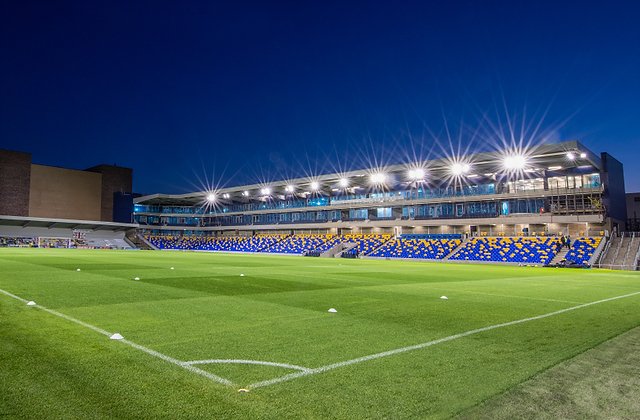
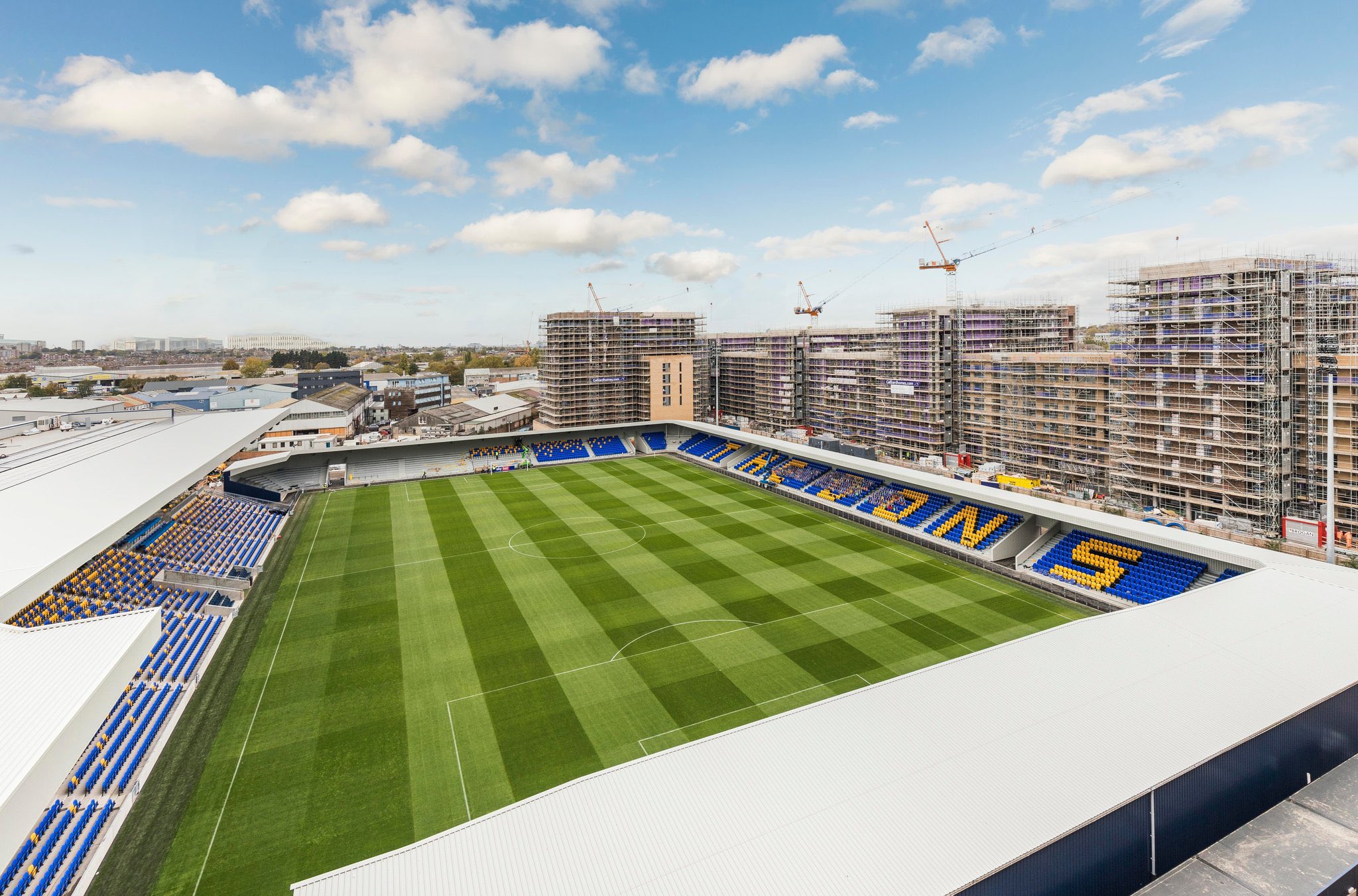 Wimbledon will share Plough Lane with the London Broncos rugby league club after a majority vote of Dons Trust members at a virtually-staged SGM.
 London Broncos fan Jake Rainbow wrote recently in the Wombles Downunder fanzine: “I can entirely understand and support the desire of AFC Wimbledon fans to be the first fans to turn out in the new home you have been hoping for so such a long time.