asd
Saturday, April 4, 2026
Home Blog Page 3

It’s The Comms, Stupid

0

THE Danny Macklin shambles yet again highlighted the jumbled messaging of AFC Wimbledon’s  communications to its fans and the wider football community.

No doubt, the sensationalist revelations of Macklin’s sexist and abusive rant about a female colleague — albeit via a concealed listening device — were hugely damaging and embarrassing for AFC Wimbledon, which takes great pride in its fans-owned ethos. The story even made its way to the New York Post! https://nypost.com/2023/09/26/afc-wimbledons-danny-macklin-resigns-after-abusive-comments/

The Club’s handling of the Macklin scandal, citing legal advice, again fitted the template of past muddled attempts at keeping things quiet and only flushed out from a bunker-like mentality into making a statement when belatedly reacting to press coverage of events.
(London Irish rugby ground share, anyone?).

The consequence of the secrecy and stonewalling is a proliferation of corrosive rumours and conspiracy theories, as was the case in the Macklin mess.

Macklin’s impropriety certainly wasn’t obvious in advance but the lengthy delay in
the club in reaching a decision indicated long difficult internal discussions to resolve the thorny issue.

Fans were left in the dark with a perfunctory initial brief club statement
of Macklin leaving the club. It took another three weeks before the truth finally emerged—through the media with the consequent bad PR that followed.

It smacks of a lack of a consistent messaging from the club. There is a disturbing ponderousness in replying to events – it takes too long to get a message agreed and published. That sheets home to AFC Wimbledon Chair Mick Buckley.

He has been serving in the role on since the departure of CEO Joe Palmer over a
year ago.

Mick Buckley

Buckley, a former CEO of financial and business television network, CNBC Europe and before that with Turner Broadcasting Europe, has been a director of the Dons Trust, the football club and AFCW PLC, over the last decade and is a lifelong Wimbledon fan.

Insiders bemoan that Buckley is not a natural communicator, as witnessed by
his meandering monologue at a Fans Forum last May. Video highlights were promised the following day for those who couldn’t make the meeting, but they didn’t materialise
in full forcing a flood of complaints from the fan base.

The club was reluctantly forced to release the recordings in full. Sound familiar? No, club comms are a recurring theme.

The club has earned an unwanted reputation with many of its fans of acting tin-eared and failing to read the room.

There is a lack of a clear comms strategy and someone to implement that strategy at events, interviews etc.. Someone who is open and willing to answer, not deflect, the awkward questions.

A third managing director since April 2019 is currently being sought. Hopefully, the club will make sure that the new MD has the comms skills, and the responsibility, to fill the vacuum.

That won’t be easy assuming they’re not steeped in our culture so they will need help. But there’s lots of goodwill out there – they just need to tap into it. Here’s hoping they address the problem – and soon. — ROB SMITH.

No Winners Out Of Macklin Mess

0
Danny Macklin

SO many questions linger in the wake of AFC Wimbledon’s bombshell announcement on September 4 (remember the date) that Managing Director Danny Macklin would be leaving his position giving just four days notice.

It was a perfunctory 61-word ‘Club Statement’, which only prompted more questions.

Macklin posted on his Twitter account (since deleted) that he was leaving because his immediate focus would be to spend “much needed time with my young family before taking up a new challenge.”

It is understood that Macklin stayed in a Wimbledon hotel during the week, rather than  making the daily commute to and from his Essex home.

It all just didn’t add up. The hasty exit came after just 10 months in the role and almost immediately the rumour mill cranked into full gear.

Only a few weeks earlier Macklin, normally a prolific social media user, said he was “pausing’ his interactions on his Twitter account (the post since deleted). But there was plenty of agitation going on behind the scenes.

Macklin may have been prodigious as MD monetizing the Plough Lane Stadium with commercial initiatives, but he made some enemies along the way.

Several long-standing club volunteers and those in paid jobs lost their positions during his time with one saying “I have my own axe to grind,” adding “Rather think that evidence (making enemies) is staring a lot of people in the face. Regretfully.”

The Club said it was looking for a replacement MD, but suppressed the actual reasons for
Macklin’s abrupt departure. There was word that the club’s lawyers were “chatting” with fan podcasts about what they were and were not allowed to say about the sensitive matter.

But the Club’s attempts to ride it out were always fraught. There were those keen to bring
things out in the open and so it all blurted out on September 25 — three weeks later — in an unexpected place, on the pages of The Times, not in the racier tabloids.

Under the heading “AFC Wimbledon boss resigns after secret recording of sexist and abusive comments,” there were mind-boggling revelations.

The Times can reveal. Danny Macklin, who was managing director of AFC Wimbledon, described Rebecca Markham, the club’s ticketing manager, as a “slut” and a “slag” and joked about assaulting her in a covert recording device that was placed in Macklin’s office at Plough Lane by a military veteran working as a club security officer.”  https://www.standard.co.uk/sport/football/afc-wimbledon-danny-macklin-resigns-b1109470.html

The bug was secreted in Macklin’s office by Matthew Wells, a British army veteran who worked as part-time security for the club, because he said he was concerned by the
alleged abuse of staff.

Wells said: “I couldn’t believe what I heard. The way he was talking about Rebecca
was terrible.” It is not clear what precipitated Macklin’s recorded rant.

The Club, which had prior knowledge that The Times was about to publish the damaging expose, subsequently issued a statement: “Behaviour such as that being alleged was and is not tolerated, nor is it representative of the culture at AFC Wimbledon. Once we became
aware of the matter we acted appropriately in accordance with our responsibilities and values to promptly resolve it. For legal reasons we are not able to say more.”

Macklin also issued a mea culpa. “I deeply regret what I said behind closed doors. The words and language I used were unacceptable and inappropriate with zero intent to act upon. They are not consistent with who I am and what I stand for. I am deeply sorry
for the words that I used which I should not have used in any circumstances. I can only apologise unreservedly to the individual concerned for the hurt and suffering I have caused.”

It is understood that Rebecca Markham left the club several weeks before Macklin. Sources say she may have received a settlement and a legally-binding non-disclosure agreement (NDA). It also implies a much longer timescale before the Club took action against Macklin, indicating long and difficult internal discussions took place.

The news of Macklin’s troubles came as no surprise to some at his previous club, Leyton Orient. “There were certainly lots of unpleasant rumours, and everyone who had to work
under him (at Orient) found him a resoundingly unpleasant person,” one observer told WDSA.

The FA said it would investigate reports that Macklin made abusive and sexist comments about a female colleague. “We are aware of the reports about the conduct of the
former managing director of AFC Wimbledon, and we will investigate them,” said an FA spokesperson.

The question that poses is can a likely NDA be overturned by the requirements of a regulatory body?

Kris Stewart

In the tumult that ensued Macklin’s hurried departure, the Club appointed Kris Stewart, the club’s foundation CEO. to fill in on a temporary basis while a permanent replacement was sought. Stewart stood down from his position as chairman of the Dons Trust Board to take temporary charge of daily club affairs, while Michele Little took over as the new DTB head.

The scandal has left the club in turmoil. The next Managing Director will be the club’s third since April 2019 with Joe Palmer and now Macklin leaving after brief spells in charge.

There are no winners out of all this murky business. Macklin faces a major challenge to get work again in football after these explosive revelations, while there are ethical/legal questions over how Wells entrapped Macklin with the concealed covert listening device.

Wells served in all major conflicts since the Falklands before being jailed for six years in 2009 after his AK-47 assault rifle accidentally fired during a confrontation with his regimental quartermaster over what he believed to be the mistreatment of a female soldier.https://www.independent.co.uk/news/uk/crime/soldier-jailed-for-firing-rifle-in-struggle-1707348.html

Wells believes he acted “honourably” in disclosing the private conversation to club officials to protect a vulnerable employee. Markham has had her photo plastered over the many press reports and is no longer working at AFC Wimbledon.

The Club has to start all over again to find a new Managing Director who can hopefully become a long-term solution. And in so doing look at the thoroughness of the Club’s recruitment processes and background checks — two employees who broke the rules, albeit in different ways, suggests there are improvements to be made.

[‘No Winners Out Of Macklin Mess’ was first published in the October-November  2023 issue of the Wombles Downunder fanzine.  Details on how you can subscribe to Wombles Downunder.]

Ivor Heller: “Endless Energy And Optimism”

0

“Within the board what I valued most was his opinion, his extraordinarily wide network – he seems to know almost everyone and, equally important, they all know him – and his absolute commitment to doing what was best for the AFC Wimbledon club.” a tribute to Ivor Heller by Erik Samuelson.

WHEN I was asked to write a piece to mark Ivor Heller’s retirement as Commercial Director, the first thing that I recalled was that whenever anyone found out I was from AFC Wimbledon their first question was always ‘how’s Ivor?’  He has always been the one people remember.

It’s not surprising really. Despite his diminutive stature (more of that later) he would walk into a room knowing hardly a soul and very soon be at the centre of an animated discussion; he had an opinion (and an anecdote to tell) about almost everything.

I first met Ivor at one of the meetings to form the Dons Trust. We were in a sub-group in one of the pokey little meeting rooms upstairs in the Wimbledon Community Centre. As a result of that meeting I came to know him better when we, along with Kris Stewart, put together a business plan to take Wimbledon FC out of administration, where Koppel was threatening to put it if the franchise deal was refused.

But Ivor came into his own from 27 May. Yes, I know that’s the day before the FA commission reported but he was tipped off early by an insider and swung into action immediately. When I came to know him better I thought it odd that he moved on so quickly because he is by nature a fighter. But when I knew him even better I realised that whenever he knew a fight was lost he’d simply direct his energy elsewhere.

The origin story of AFC Wimbledon is well enough known by readers of the Wombles Downunder fanzine, but let’s dwell on it for a moment. What was achieved in those few short weeks was extraordinary.

I asked Dave Anderson for his memories of Ivor and he summed them up as ‘endless energy and optimism’.  And they were a key element that ensured AFC Wimbledon was created.

It often struck me that it must have looked odd that we got along so well. After all, we are opposites in many ways. While he could always argue a case it often felt to me that a lot of his judgements were rooted in gut feel whereas I preferred a more analytical approach.

Ivor with ‘The Beast’ Adebayo Akinfenwa

Ivor always thought about how to present things visually whereas I’m more at home with words and numbers. When it came to people he would quickly form a view and on the rare occasions where we appointed someone we regretted he’d suss it well before I did.

So in a perverse sort of way it turned out that despite our totally contrasting styles we worked together really well. Ivor is a free spirit, so we agreed a broad remit and I left him to get on with it. And because we shared similar values and objectives and talked regularly, it was a very rare event where I had to refuse a course of action he wanted to take.

Within the board what I valued most was his opinion, his extraordinarily wide network – he seems to know almost everyone and, equally important, they all know him – and his absolute commitment to doing what was best for the club.

One of the most obvious things about Ivor is his height. He uses this to effect when, for example, if something is dropped on the floor ‘I’ll get it – I’m nearer’.

Ivor with English football’s tallest player and former Dons loanee Kyle Hudlin (2.1m)

When he was due to speak at a Football League meeting he walked up to the lectern, peeped over the top, said ‘hmm, maybe not’ and stepped to one side to start his presentation amid loud laughter from the floor.

And when we were in 10 Downing Street to receive a Big Society award and David Cameron made a stupid joke about his height, Ivor dealt with it with great grace. And he could laugh about it too.

I remember when an opposition chairman told us he selected his people by reference to their star signs just as Ivor walked in. So I replied that I selected our staff by height; Ivor nearly choked with laughing and had to leave the room.

There is something about Ivor and royal boxes. Most readers will recall that after we’d won the League 2 play off final and in a state of euphoria, Ivor flicked Vs at a mate from the royal box.  I think that one went viral.

It was followed by some club employees sending him a spoof letter from the FA asking for his comments.  He wasn’t the only one to fall for it – at first I thought it was genuine too!

And then there was the royal box at Wimbledon.  As CEO of the club I was invited to their royal box for several years.  I always understood that it was the role that was invited, not me, so I wasn’t surprised that the invitations stopped after I retired.

The first time I went I thought it was about business networking so I took Ivor as my plus one.  And he distinguished himself with a comprehensively failed attempt to chat up actress Kim Cattrall.  She put him away so effortlessly that I stood in the middle of the reception area, away from the tennis, helpless with laughter.  I can’t remember laughing so long; I was so loud and so out of control that Ivor had to walk away from me!

To be fair to him he is just as likely to tell that tale as I am.

Another feature of Ivor is that he always seems to know (or claims he does) everything that is going on.  So Terry Brown was cheerfully mischievous in hiding the name of his first signing from Ivor.  It was at a meet the manager session that Terry told everyone he’d like to introduce them to his first signing – and in walked Marcus Gayle.   The look of surprise on Ivor’s face was a picture!

What else? Well running a football club you attract controversy, conspiracy theories and criticism, especially if you’re as high profile as Ivor. What always impressed me was that if someone attacked him he’d contact them and offer to talk about it.  He’s always been full frontal in confronting difficulty and not letting things fester.

Ivor with one of his favourite players and former Dons manager Glyn Hodges

One thing that I think we’ve done well as a club is to recognise and honour the past and a lot of that originally sprang from Ivor. He made sure that former players were invited and made welcome; he seemed to know them all. And he has an eye for history. So when we returned to the Football League in 2011 it was Ivor who got permission for a one-off change to our strip so that we could wear a replica strip as close as possible to the kit we wore when first we entered the league in 1977. These things matter and, let’s be clear, they were also good ideas commercially…

And then there is his extensive work for the community which was often done below the radar.  It has largely been unnoticed and unsung but he has been a great supporter of many charities across the borough, notably with The High Path Estate, and helped some of them to raise major sums.  He also instigated a renewal of hospital visits by players at Christmas.

Eileen told me that I forgot to say how kind and thoughtful Ivor can be.  I couldn’t attend the first Sutton friendly so it was one of the very few games she attended without me.  Despite the huge pressures surrounding the event he still found time to make sure she got a seat and was settled.  I often saw similarly kind and thoughtful acts on his part.

Ivor at a post-game man of the match presentation with Ayoub Assal

Well I’m nearly at the end and I’ve not mentioned his work as auctioneer at club events, hosting hospitality, engaging with sponsors and would-be sponsors, and telling our story to those who would listen and some who didn’t want to!

He has worked tirelessly for the benefit of the club and at some personal cost.

There comes a time when we should all move on and now that time has arrived for Ivor. The club is so embedded in him, and vice versa, that I suspect he will sometimes find that difficult. But I am absolutely certain that if a call for help comes from the club he will be there like a shot, bubbling over with enthusiasm, energy and optimism.

There’s lots more I could say but I will sign off with a statement of the obvious which I hope people will not forget: we wouldn’t have a club or a new stadium without Ivor. Well done Mr Heller!


[Ivor Heller: ‘Endless Energy and Optimism’ was first published in the March-April 2023 issue of the Wombles Downunder fanzine.  Details on how you can subscribe to Wombles Downunder.]

Banking on Youth

0

TWENTY-plus years on AFC Wimbledon club co-founder MARC JONES views the club’s youth scheme as the jewel in the crown. He writes “we’ve been smashing it for some time now and it shows no sign of slowing up.” Some great insights in this pulls-no-punches look back and forward ….

WE are 20 years in now from a scatty idea about what to do after an extinction level event. How we doing? That’s a massive question to answer succinctly so it’s probably easier to pick one facet and sum up the wider picture using that as a motif.

One thing we didn’t discuss at the start of the new chapter was youth players. Sure, we got a lot of kids come to play for us at the trials and beyond, but we didn’t kick off in 2002 with a masterplan. At least not all of us did.

Thankfully, Nigel Higgs gave it focus. Even more thankfully he was pretty much left alone to get on with it and when he bumped into Mark Robinson — well, that was our version of John and Paul at the garden fete of St Peter’s Church, Woolton!!

Nigel Higgs

From kids paying subs for their kit (including Will Nightingale) and dads running their sons’ sides we grew over time into what I have called and continue to consider the jewel in our crown.

Listing success stories to back this up would not only be a roll call of obvious names but it would also eat into my word count.

Suffice to say we’ve been smashing it for some time now and it shows no sign of slowing up.

Not only have our players gained plaudits and approval but we’ve also seen coaching staff move into Championship-level clubs.

When we seemed to not really have a grasp on what we were, who we were and our why  (the very thing Robbo went on to talk about when he finally got the job many said he could have done earlier) the Academy seemed to have it nailed.

Unashamed of our past but not stuck in it the youth set-up was always proud of what Wimbledon meant….. work-rate, humility, drive.

All more than abundant in the latest young bucks plying their trade amongst World Cup and 400+ career players.

Neal Ardley always struck me as someone wanting to get out from the history of Wimbledon like a son trying to prove his millionaire father he was good at business in his own right.

To the point of defying it so aggressively we lost our way under him eventually. It wasn’t hard to get his staff to scoff at how we used to play — you simply can’t head-butt people now —  a well-worn fable about how the Crazy Gang was perceived in that Ardley as manager era.

Sure the game has moved on but hard work, in-your-face football can work – ask Johnnie Jackson since his epiphany at Bradford when we seemed to be reborn led by the aforementioned Will Nightingale.

The Academy revered that past glory like the fans did. Why shouldn’t they applaud a side stuffed with our own tearing up the rule book and defying anything that dared suggest we were not worthy?

Anyone who has seen the youth sides in action can see this running throughout them like a stick of seaside rock. Winners do more is a direct descendant of that Yidaho! FA Cup era where the players had to be dragged off the pitch the night before a cup final.

If there was ever one issue that nagged me it was young players getting into the first team squad, being assimilated and picking up bad habits in place of the good ones they arrived with.

Robbo saw this from afar and it was the first thing he straightened out when he was given the first team hot seat.

Mark Robinson

How it had crept in was probably that modern illness described as player power. A Robinson-led reset that didn’t quite keep us up but that aforementioned player malaise would be unthinkable now given not only how Johnnie Jackson runs the place but also the blossoming connection between player, staff and support.

Plough Lane is gradually making more and more sense and there is a feel of it coming together in a way we all hoped for but didn’t actually believe would take place given how much gloom had settled in. At times Plough Lane, for all its homeliness, was starting to feel like a haunted house.

Setting up loan spells for the younger players, keeping more of them on contract than we had previously was a gift, or even a legacy if you will, of Mark Robinson’s work as not only loans manager but also first team manager.

Hopefully, seeing the likes of Osaze Urhoghide [now at Celtic and on loan to KV Oostende in Belgium] walk away for free, unwanted and straight into a Championship club are gone forever.

Instead we have a new problem — keeping these starlets long enough to even see them kick a ball in a first team game.

Leon Chiwome

This pre-season saw not only Jack Rudoni sulk his way to Huddersfield whilst helping balance the playing budget but also saw Archie Stevens depart for Rangers and Leon Chiwome move to Wolves — both for a rumoured £100,000-odd each.

Chiwome https://academy.wolves.co.uk/news/chiwome-rewarded-with-professional-contract/ has since hit a hat-trick for England in only 48 minutes just four days after his 17th birthday. It makes you wonder how much more we might have got had we kept him a little longer than six months!

It’s clear that clubs with money to burn can make what is a fairly low-risk gamble on our youth players and whilst you’d hope a decent sell-on and clauses exist it remains frustrating the Dons faithful didn’t really ever see them much outside of academy matches.

Morgan Williams

For those interested my recent picks from the youth matches I’ve seen have been Morgan Williams (hardly unknown to most as he’s been superb for a long time) as well as Aron Sasu and Sean Sankanu.

Sasu has been in the first team squad already this season, Sankanu is an absolute powerhouse centre-back who talks (well, shouts) non-stop and leads the back-line with real authority.

This last transfer window featured the understandable departure of Ayoub Assal.

Ayoub Assal

A life-changing move for him but a sad and slightly disappointing end of a love affair with fans who were prepared to watch a bit of attitude and insolence in return for moments of sheer explosive joy. That kid was bottled lightning and I will really miss his antics.

Not only did we have to contend with losing our maverick from Morocco but thE mid-season window also had our nerves shredded as Bristol City circled overhead with an eye on Jack Currie – thankfully the window closed with this being one takeaway that didn’t get delivered.

So what next? I think the club have to restate what the MO is.

Jack Currie

A great academy being pillaged for 16-year-olds and players with 35 games under their belt might feel like a pat on the back.

But we must consider the narrative of  home-grown and available at the right price versus good, well-paid deals for our own players who might just push us on to greater things and a time when only the most insane monetary offers or career-defining clubs should get a chance to steal our diamonds.

Huseyin Biler

If I’m not watching Huseyin Biler for a couple of seasons I’ll know we are not quite there yet but I’d like [Head of Football Operations] Craig Cope to say hello and let me in on his plans for the future — I want to see how bright it actually is.

Why on earth the club didn’t introduce Cope to the fans is completely beyond me — it’s a much-needed important role we took almost a year to fix.

I’d have organised a brief intro first week with him at some stage telling us what his vision is. Because it will be his vision.

Cope’s here to draw it all together top to bottom, Under-11 to highest-paid player and let us all have some concept of what a Wimbledon player is, where they come from and how long they remain one.

If the manager moves because he gets a better offer or fails I expect Cope to remain in the post and hopefully offer something approaching the continuity Mark Robinson’s reign as Academy guru and beyond afforded us.

Now, wouldn’t that be something special?

“Every game is a joy – but this moment, 34 years in the making, will take some beating.” Author Marc Jones with Dons great John Fashanu …

[Banking on Youth was first published in the January-February 2023 issue of the Wombles Downunder fanzine.  Details on how you can subscribe to Wombles Downunder.]


The Greatest Don

0

THERE wasn’t much in it — as you would expect — but Robbie Earle has been narrowly voted over Nigel Winterburn as the Greatest Don by a WDSA panel of fellow Dons fans. This poll might have taken some time for fruition in Wombles Downunder but sure you all will enjoy the stroll down memory lane reading all  the endorsements. **The poll does not include players from the AFC Wimbledon era.

ROBBIE EARLE

Robert Fitzgerald Earle MBE.  Two clubs adore him. Port Vale pip us by ten games to the most appearances per club out of his 578. A Rolls Royce midfielder from the modern era with very few peers. Unfathomably overlooked by England he went off to the World Cup to prove his class for Jamaica. Tireless, seemingly as fit as Steve Austin with even better vision. Non-stop, next level class. He had the absolute lot. We will never see a better player let alone a better goal scoring midfield genius. – Marc Jones

The ultimate box to box midfielder – Robbie Earle was the driving force behind the club’s Premier League teams that defied the odds throughout the 1990s. His goals to game ratio was such that ‘the Duke’ was called up by Jamaica for their 1998 World Cup campaign in France where he scored the Reggae Boyz first-ever tournament goal. His injury-time equaliser at Old Trafford in the 1997 FA Cup epitomised the man and that team – just when it looked as though they were beaten, he got free of his marker to power home an unstoppable header. – Stephen Crabtree

From scoring for Wimbledon at Stamford Bridge on his debut, to scoring for Jamaica in the World Cup. From the header at Old Trafford to the over-header against Spurs. From scoring at Anfield and Highbury what felt like every day of the week. From box to box. From season to season. He ran for Wimbledon. He was Wimbledon.—Lee Willett

I don’t think anyone could present a strong argument against Robbie Earle. He endeared himself to us immediately with goals in his first three matches and never really looked back for the best part of a decade. Who’s to say how much the subsequent timeline of events would’ve been altered had he not got injured midway through the relegation season! – Mike Taliadoros

The Dons signed Robbie Earle in 1991, when I was 9 years old and fast becoming a Wimbledon obsessive. He quickly became my favourite player and the first name I had on my shirt. One of the Premier League’s best performers in the 1990s, he scored 59 goals from midfield in 284 appearances, including some belters (my favourite being the overhead kick vs. Spurs). – Tim Hanson

For me the greatest Don would have to be Robbie Earle. I will never forget is his goal at Hillsborough in the FA Cup quarter-final, the year we thought we would go on and win it again….. and maybe should have done….. or the pride I felt when a Wimbledon player scored in the World Cup finals (for Jamaica).—Tim Nicholls

Robbie Earle epitomised professionalism during the most successful period in Wimbledon’s history. He provided focus to the Crazy Gang, clocking-up 284 games and 59 goals over nine years. An attacking midfielder and a modest person, Earle’s understated abilities earned him a place in Jamaica’s World Cup team of 1998, where he scored their first-ever goal.—Gary Walker 


NIGEL WINTERBURN

Player of the year every year he was here, in four seasons we won two promotions and achieved our highest-ever league position each year. I’ve never seen a better tackler, or more effort. After leaving us, he won more honours than any other Don – three league titles and four cups with Arsenal – becoming part of the meanest defence in English football. There’s no contest – it has to be Nigel Winterburn! – Tim Smith

Winterburn joined Wimbledon for free when they had just been promoted to the (old) 3rd Division. Twice instrumental in promotions with Wimbledon, he left when we finished 6th in the First Division with Arsenal paying £400k for his services, Won Wimbledon Player of the Year in each of his four seasons with the club. A study in greatness – Joe Blair

Anyone who knows me would not be surprised to know my nomination is Nigel Winterburn. He was a superb tackler, hard but fair. Like some others in that promotion-winning team he also had more skill than he was given credit for. The fact that he was voted Fans’ Player of the Season in all four seasons he was with the Dons speaks for itself, especially for a full-back. A shame he left before the FA Cup triumph, but he will always be remembered as one of our greatest” – Liam Nolan

The definition of “greatest” is subjective. Is it someone who’s technically the best, had the best record, or the longest career? For me it is someone who meets all those criteria: Nigel Winterburn. He’s the best left-back we’ve ever had and went on to form part of a formidable defence at Arsenal.—Colum McAndrew

The vision of Nigel Winterburn thundering into tackles and storming down the wing will remain etched on the memories of those lucky to be visiting Plough Lane between 1983 and 1987.  ‘Nige’ received the supporters’ PotY award in each of his four seasons with us, whilst the club progressed from playing at Scunthorpe in Division 3 to doing the double over Manchester United in Division 1. Incredible! – John Martin

DAVE BASSETT

As a combative midfielder, Bassett helped Wimbledon to win three successive Southern League titles and then establish themselves in the Football League. After becoming manager in 1981, he soon piloted the unfashionable Dons from the Fourth Division to the top flight via three promotions in four seasons and with largely the same nucleus of players. – Ray Armfield

My choice for the ‘Greatest Don’ would be Dave Bassett. His achievements as a manager taking us from (old) Division 4 to the first division was remarkable. Secondly, he created a brand which got world-wide recognition. And thirdly he also played a significant number of games as a player and was part of a successful non-league team that got Wimbledon  into the Football League.—Rob Bushaway

After 180 games as a player, Harry’s masterminding of the rise from Div 4 to Div 1 was astonishing, as was the sixth-place finish in our first season in the top flight. My first match was in the 82-23 season, so I joined the Dons at just the right time for the crazy ride! My two mascot appearances were with Harry in charge and I still remember having to leave the dressing room while he delivered his motivational team talks! – Stefan King

ALAN CORK

Our record League appearance holder (430) and top goal scorer (145) over fourteen seasons, Alan Cork gets the nod from me.  Fighting back from a broken leg and thirteen months out, he came back to make a substantial contribution to the Dons’ rise up the Football League pyramid.  He was rewarded with a start at Wembley put in a valuable shift. Corky is one of the reasons why I support Wimbledon. — David Kenwery

My first Womble hero was our greatest league goalscorer, Alan Cork. More appearances and more goals than anyone else and nobody contributed more to our rise up the leagues. He could score with either foot and with his head. Corky was even a centre-page poster boy in ‘Roy of the Rovers’ and was on my bedroom wall for years. He had no hair and I really didn’t care. Legend.—Steve Dowse

Corky was a key reason why we galloped through the divisions in quick time to become a famous Division One team. Playing in all divisions, with or without hair. he was such a prolific striker. As Harry once said “He runs like a duck but he’s a goal scorer.” I doubt we would have achieved all that we did without him.— Paul Russell

STEVE GALLIERS

The feisty midfielder was the first Dons player that came to mind. I watched him play back in the 1980s. Not big in stature but made a big impression! Dynamic, determined, aggressive, I thought he could play a bit too. A northern lad, apparently, but a proper Womble, embodying the kind of never-say-die, underdog spirit that I think many Dons fans relate to.—Terry McFadden

I’m nominating Steve Galliers. A pocket dynamo, like me short of stature, but unlike me had no problem kicking bigger players all over the park and telling them why he’d done it. This included Dave Bassett who Galliers kicked so hard in one game for Chorley that we signed him for the Dons at the next opportunity. Legendary player in my favourite Dons team.—Trevor Pearce

DICKIE GUY 

He is my stand out Dons legend for his iconic role in the 1975 FA Cup Leeds game.  As a young boy, his penalty save hooked me to Wimbledon;  I’ve loved the plucky underdog, never-say-die spirt of Wimbledon ever since.  A key figure in our rise from non-league to the Football League, Dickie remains one as club President at AFC Wimbledon.  A lifelong Dons servant,  he is my  all time  great. — Peter Leng

I am torn between Wimbledon legend – more than 500 first-team games – and now AFCW president Dickie Guy for his brilliance as a custodian and his ongoing contribution to Wimbledon, and Harry Bassett for his tenacity in midfield and, more importantly. his time as manager, steering the club from the Fourth Division to the First only nine years after it joined the Football League. Forced to choose, I’ll plump for Dickie Guy.—Jason Steger

JOHN FASHANUHard  to overlook  the  likes of Corky, Lurch, Vinnie and REMBE but I’ll say Fash –  because he was  the best in the world at what he did. There wasn’t a centre back on earth who could handle him on his day. He could chip a goal from 30 yards, smash it in from the edge of the box or bundle it over the line and that’s before we get to the 15 headers a season. Awooga, indeed— Graham Stacey

 VINNIE JONESFrom the Wimbledon FC period I’d have to go with Vinnie. Not everyone’s cup of tea but he played for the Dons in two spells. We always seemed to do well when he was at his best, although I won’t forget that bone-crunching tackle on Steve McMahon during the 1988 FA Cup Final win, nor that moment with Paul Gascoigne. A character who broke all the rules but loved the club with a passion. — Andy Powell

CHRIS PERRYChris Perry, ignored by England and loved by the Dons. “The Rash” was one of the very best. Fairly slight and not tall, he still was one of the best centre-backs I have seen live. “Chris Perry,  give me your jersey, cos I want to play like you……..”  – Xavier Wiggins

ROY LAW —  My boyhood hero. The epitome  of captain, leader, legend. Very unlikely that his  appearance record will ever be beaten.— Paul Jeater

[The Greatest Don was first published in the November-December 2022 issue of the Wombles Downunder fanzine.  Details on how you can subscribe to Wombles Downunder.]


The Dons Local Action Group interview

0

ONE of the proudest and enduring achievements of the fans-owned AFC Wimbledon is the flourishing volunteer Dons Local Action Group and their inspirational caring work in the community. Co-founder Xavier Wiggins tells the DLAG story in this WDSA interview ….

(i) Firstly, how did the Dons Local Action Group (DLAG) come about? Who were initially responsible for its formation and what were the intentions behind it?

Xavier: Craig Wellstead, Cormac van der Hoeven and I had been very active on the Plough Lane Bond. We had a big team in place who had been tirelessly leaflet dropping, standing outside train stations and shopping centres, etc.  We were all on a WhatsApp group. When COVID hit on the 15th March, I messaged the group, suggesting we do something. It went crazy from that point. Five days later we had our first food distribution hub in place and a table outside Morrisons in Wimbledon town centre. We were collecting food from shoppers and the energy-plus willingness to help was incredible. People use the word “humbling” excessively, but this really was. An amazing few days were followed by amazing weeks and months. 

Craig Wellstead – Co-founder
Cormac van der Hoeven – Co-founder
Xavier Wiggins – Co-founder

(ii) Starting out at the onset of the COVID-19 pandemic how were those initial weeks/months delivering food to vulnerable and self-isolating residents, establishing collection points and what was the response you all received from the local community?

Xavier: Everyone wanted to help. People were standing outside shops. Driving deliveries. collecting prescriptions. running errands. sorting food at the hub. Getting our social media established. Finding new shops to open new venues. The community really needed something to rally behind. They wanted to do something useful. People were often terrified. Not just the people we were delivering food to but many volunteers as well. Lives were turned upside down. People were falling through the gaps. Our phones were ringing hot. Politicians, media, people who needed help. It was incredible. 

(iii) What other spin-offs did the DLAG evolve into? Thinking what became a perceived need to support children who didn’t have access to a computer at home. Tell us about that initiative and what has developed out of it?

Xavier: Schools obviously had to close but little consideration had been given as to how they could continue their education. The brilliant Siobhain McDonagh MP got in touch and asked if we could help to supply laptops to a temporary homeless shelter. It just went from there. Collecting, wiping disks, restoring and distributing laptops. 

(iv) DLAG also has branched out into sourcing and supplying essential furniture and white goods to local residents. This all obviously takes some organising to arrange pickups and deliveries. Give us a sense of how that all works within this collective?

Xavier: We have a furniture hub and we pretty much ensure that furniture is sourced on demand. In the early days we would put out calls for a washing machine on the WhatsApp groups and within five minutes we’d have 10 pledged. Some of them were from people who just offered to buy them. They trusted us to make sure the goods were going to the people who most needed them. Then we had other disasters. The family who got burnt out of their home and only had the clothes they were standing up in. Paul White, Councillor for Tooting, called us and then sent us a list of everything from pillows to pants. It was a big list. We got pretty much everything on the list in 24 hours. Then. more recently, there was  a gas explosion that killed one and evacuated hundreds in Galpins Road, Thornton Heath. We needed to help in the aftermath of that tragedy in a number of ways. And we help those people fleeing domestic violence with basics as well. 

(v) It is all synonymous of the volunteer work-force ethic that separates the fans-owned AFC Wimbledon from other clubs. Was that a guiding principle among your DLAG cohort?

Xavier: DLAG is a machine. We have clarity of vision and a passionate belief in our impact. People follow that and together we know that a few hours a week can change lives. That is one hell of a driver. The power of a football club’s fan base to unite and do amazing things is immense. We feel a responsibility to our community. It isn’t just Wimbledon fans either. Far from it. But, as a fan, I believe that we don’t take no as an answer. We see the obstacles and smash them down. That’s what we’ve done as a fan base. That’s what we’ve done as DLAG. We have built partnerships with so many great groups. Old Ruts. Old Wimbledonians. Actually, there are just too many to mention. And it provides massive secondary benefit to the football club as well. 

(vi) DLAG has had an amazing reach, it has become an inspirational beacon of what can be done when people get together to help others in these hard times. What recognition/awards have DLAG received throughout its two-plus years of existence?  Give us a sense of how many people are now part of the DLAG community?

Xavier: The trophy cabinet in the museum at Plough Lane is bulging and it is a source of great pride. I won’t remember all of these but off the top of my head: Sports Journalist Awards (alongside Marcus Rashford). BT Openreach Connector Awards. Merton Business Awards Best Charity Awards. Football Business Awards. British Citizen Awards. There are literally loads more of accolades. As for our numbers, since the start we have had over 2000 volunteers involved. Nearly 600 have volunteered so far this year. 

Dons great John Scales and daughter Willow

(vii) Given how all this started out back in March 2020, have you got the support/imprimatur of AFC Wimbledon and where do they also help out? Where do you get the money to keep all this work going? Surely, the club has benefitted from the social work/outreach of DLAG within the community.

Xavier: We have various sources of funding. Our two annual events are vital. The coming sleep out on 3rd December is massive for us and the Family Fun Day is massive too but watch this space on that. We get support from the council, who actually realise that we can operate far quicker in some situations than they are able to. They have been brilliant to us, by the way. Particularly, Merton Council. Lots of people are starting to fundraise for us now by running in marathons and other things. Even just recently a bunch of people from a pub did a walk around eight Youngs Pubs. We want to keep saying yes to those who need us. Be they families or food banks and other charitable entities. But to do that we need money. DLAG isn’t cheap to run. [We don’t really talk publicly about our funding as we fall under the AFCW Foundation. And there are no formally validated figures.] Being honest, I think the club could do more. That isn’t a criticism. It’s just a fact. Now that we have emerged from the pandemic and have settled into beautiful Plough Lane I’d like to see the club throw its full weight behind what we’re doing. There are many positives and people are busy. Let’s see how far we can go. We are getting some really good buy-in from some staff members and I look forward to that becoming more widespread over the next few months. DLAG provides fantastic recognition for the football club. We’ve had many people, who opposed the building of the stadium, now saying that they were wrong and that now they’ve seen what we do they are fully behind it. That makes me, as a Wimbledon fan, pretty emotional. We are creating new fans for the club. We are showing that football clubs can have more meaning than 3pm on a Saturday. 

(viii) Looking back on it all, what gives you the most pleasure/satisfaction from the whole operation?

Xavier: The people. If I ever get down in the dumps about things I just think about the number of people out and about doing stuff for DLAG to support those who desperately need us in these ridiculously tough times. People can be amazing. Truly inspiring. I’ve made friends for life from this. And I want DLAG to continue offering vital support for decades to come. 

(ix) And finally, what is the future of DLAG? Can you see it developing even further within the local community?

Xavier: Yes. Poverty is not going anywhere. We have a crucial part to play and I am really excited about the next chapter for the organisation. We need to remain focused on fighting the effects of poverty. And we need to be brilliant at it. We need to galvanise more great people into helping us. One of my big learnings is how much helping others actually does for your own self-esteem and worth. I hadn’t really considered that at the outset. I want us to lead from the front. To be on the absolute frontline of fighting the effects of poverty. 

[The Dons Local Action Group interview was first published in the November-December 2022 issue of the Wombles Downunder fanzine.  Details on how you can subscribe to Wombles Downunder and read more.]

The Dom Teuma Interview

0

(i) Firstly, Dom, a bit of background on you. What is/was your line of work and how (and when) did you come about following the Dons?

Dom: I was not previously an ardent Dons fan, albeit they were my second team. I am first and foremost a football fan living in SW London all my life but specifically SW19 since 1984. I went to a few games at Old Plough Lane and also a few at Selhurst Park. I was an Arsenal fan due to family connections in North London but this all changed in 2002. I was drinking in the Crooked Billet in Wimbledon Village and there were leaflets going round that the club was going to start afresh. My sense of injustice to what was  happening to my local club with the move “up there” fired me up to fully get behind the new entity. That was it, from seeing European finals, FA Cup wins and Premiership wins there was a greater joy out there and AFC Wimbledon was it. I am a fervent advocate for fan ownership, I am aware as a previous businessman that there are challenges, but with talented people all pulling together, there is every opportunity to progress the club. I believe in dreaming big. I am retired, having sold my technology  business in 2007. I am good with languages and I have experience in Banking  HR, Sales and IT. I like to make things happen.

(ii) What made you decide to tramp around South London to get businesses to put up AFC Wimbledon posters and attract more fans to go to Plough Lane matches?

Dom: We had been away from SW London for 32 years and the club needed to awaken and reintroduce itself to the local community and surrounding areas. The club has a debt and we needed to fill the stadium. We needed revenue. I  wanted to do everything I could to attract new supporters, boost attendances and get the cash rolling in.  The good attendances last season  held up well  despite our winless streak. Was I just putting up posters or was I building relationships? Yes, I did feel like I was on a mission. Restaurant owners, insurance companies, barbers, glazing companies, cafes, locksmiths all embraced their new stadium and fans-owned club and they knew this club was different, “more than a football club.” They were happy to put a poster up. The role is much more than using cello tape and sticking a poster on a glass front; shop keepers like to chat and it gives me an opportunity to tell them about our fan ownership ethos, the stadium and opportunities for them to use the hospitality areas and space.

(iii) Give us an idea of the territory you have covered on foot, maybe an estimate of how many businesses you have personally canvassed? How has been the response overall? Are you receiving feedback that new fans are now going to see the Dons?

Dom: I have canvassed about 150-200 businesses. I am planning to put out a map, and yes it can only be done on foot. SW London is a pretty big place and its high streets are very busy places. You simply cannot drive around. I have travelled as far north as Balham with its well-heeled residents and Victorian houses, through to leafy suburbia  Raynes Park in the south, walking  between 2-4 hours a day. Along  Tooting Broadway I tell shop keepers there is a stadium 5-10 minutes drive away, it’s been there for two years. Whereabouts they ask? Our stadium builders did a fantastic job in making our new stadium as unobtrusive as possible. It is very difficult to gauge the impact of the fixture posters, a bit like billboards along a highway. All I can say is we had a 27-game  winless run last season and attendances held up pretty good. I have had shop keepers/cafe owners telling me  people stop by to read, and note upcoming games.


(iv) Give us some of your favourite anecdotes of your poster crusade, any particular encounters stick in your memory?

Dom: The best has got to be the Verace Italian restaurant along Garratt Lane towards Earlsfield. I have an Italian heritage so I felt at home. On stepping inside there in the corner was their regular customer Andrea. I first introduced myself to Michele and his partner Andrea soon joined in the conversation and before I knew, the two owners were outside the street and there was Andrea ready for a photo shoot and she spontaneously started singing. This I captured on video. It tickles me each time I see it. At Wimbledon Glass Haydons Road there’s John always welcoming and loves to talk about his beloved Crystal Palace. Ian at Earlsfield plumbing supplies would reminisce about going to Highbury in 1970s. I enjoy meeting people, listening to the their thoughts of the day, chatting and moving on. Another joy was the Indian shop keeper at Wimbledon Newsagents Plough Lane who proudly wanted to show me his hand-written fixture list behind the counter. I hope to leave a bit of good about AFC Wimbledon when I say good-bye. They always welcome me back. It’s more than sticking up a poster.

(v) You are an ardent supporter of the fans-owned club model that runs AFC Wimbledon. Tell us why, in your opinion, it is so important for AFC Wimbledon’s future.

Dom: I am ardent supporter of the fans-owned model. It is the most significant reason why I follow AFC Wimbledon. Being fans-owned is important so we can forever be in control of our destiny. AFC Wimbledon has reached heights we could only dream about in 2002. Who is to say we should stop dreaming. Can we reach the Premier League? Can we be like SC Freiburg the German fan-owned club which went from 3000 fans to 35000? We are only limited by our own efforts and vision. Yes, I accept football is about winning, but it  is also about belonging and being together. I believe we can show the football world that we as community club with the wonderful DLAG (Dons Local Action Group) that there is a different way to exist. DLAG was a spontaneous response to community needs during the COVID pandemic, it won national awards because of the speed it happened. It grew exponentially for the whole duration of the pandemic and remains now an established vehicle for supporting those who in need, reverberating for good around the stadium and beyond. Do we wish to be the trinket on a billionaire’s wrist or a  money-making machine for a consortium? We will have highs and lows (the latter comes with the territory). But there is no doubt, in my opinion, that people get a feel-good factor from a fan-owned club, steeped in the ethos of supporting the community and a club that is different because of its essence. There were Chelsea fans who felt tainted by Roman Abramovich and now come to Plough Lane. We are on the threshold of a new era and we need the new MD, the full-time paid staff, the Dons Trust Board, the volunteers, the DT members and all the fan base to be in unison. Will younger fans follow us? Absolutely, if we make them feel they have something special and show them they are truly on this journey with everyone in concert. Together is a mighty force and we can achieve our next dream.

(vi) Have you had much support helping you deliver these posters, club backing, or has it largely been a labour of love? Maybe this is a good opportunity to appeal for others to join/help in your crusade.

Dom: Mick Buckley, interim chair, picked up my work and called me in August to thank me. He wanted the club to fully support me and said he would be re-releasing the video of my work which was published on the official club site in April to attract volunteers to help. The DT Board members do value what I am doing but unfortunately because of the difficulty and challenges of travelling on foot around busy London streets, I have had only one person come forward, the great Charlie Huyn. My hat goes off to Charlie, who has been active in supporting the Women’s team,  I saw some small handmade posters, in shops, this was Charlie’s work. I also bumped into a London Broncos fan, walking along my trodden trail. His team rents our ground. I was asked at Earlsfield Dry Cleaners to put up his smaller poster. I kindly obliged for our tenant. Yes, it is challenging work. The work involves me seeking the business owner out, and requires sales experience or at least a confident ability to talk. The role means you are working alone, walking between 2-4 hours in a stint. Ideally I would have liked to slice up SW London into 10 areas and for 10 volunteers to take up areas near where they live. Fortunately, because of my seniority, I have free travel passes. I guess new  volunteers have to be of senior age with free travel passes, have sales experience and be prepared to give up a fair amount of free time.  I would like to think 200-300,000 people have seen my posters across SW London and if get 1-2% attending a game then that’s of some value.  I am  reporting to the club’s head of Revenue, Operations and Ticketing Bal Srai and we have devised  ticket incentives to businesses who display a poster. I hope to have a gaggle of shopkeepers in the stadium for a photo. I hope my Australian Womble friends down under enjoy reading about my poster odyssey. Your interest is a spur and directly felt here in London.


The Nigel Higgs Interview

0

HE is the architect of AFC Wimbledon’s acclaimed Academy/youth set-up. In this rare interview with WDSA NIGEL HIGGS talks of the struggles to get it up and running and how he brought in a transformative coach who was to have far-reaching success at the club.

(i) Can you give some background to your support of Wimbledon, did you play any football, what do you do in your professional life and how did you come about playing a role in the formative years of AFC Wimbledon?

Nigel: Professionally, my skill-set is in IT strategy and solution development, specialising in data and databases. I own Data To Value Ltd which is a niche consultancy specialising in data architecture and management. I  moved to London from Salisbury in my mid-20s when I played at London Sunday League Premier and Surrey South Eastern Combination, or in today’s terms Step 7/8. Following Euro 96 my eldest daughter Nicola, became really keen on football and with her younger sister in tow we all went to Selhurst to watch the Dons. We heard about the Wimbledon Independent Supporters Association and their campaign  against the proposed merger with QPR and decided to join and go along to their meetings. We then got involved with the formation of the Dons Trust and I stood and was elected on to the first Dons Trust Board.

(ii) You became a figurehead in the establishment of a Academy for young players at the club. How did it come about? Tell us about what you saw as the role, the ethos and benefits of an Academy at the fledgling club?

Nigel: So many things had to be done in 2002, people got involved. The football club leaders were focused on the first team and the ground. I was the board member with the most interest in playing and coincidentally I was doing an FA coaching course. When we decided to run the match day academy for young fans at Kingsmeadow athletics adjacent to our stadium before home games the DTB needed oversight and I was appointed as the representative for ‘youth and community football’. Around that time Terry Eames was promoting the idea of forming a youth section to play in the local boys’ leagues. In my new role, Lou Carton-Kelly and I met Terry and several of his non-league associates who were integral to us being able to attract the best local players and teams. I saw my role as the club/Trust oversight of what Terry and co. were doing with their youth teams. It turned into a learning exercise about youth football and what it could and should be for us. Our ethos evolved around being player-centric, emphasising technique and trying to ensure that boys had a rewarding experience with us. In the early years this was focused around making them feel part of the club. This experience led me to see two key elements underpinning what we needed to do: that youth development is part of the club’s DNA, largely because of the successes of Wimbledon FC in bringing through local talent, and is held in high regard by our fan base and if we could do the same it would build on our story that if the club was to achieve its dreams then we would need to professionalise our youth development so it was ready for whenever we got our place back in the EFL In 2003/4 the Dons Trust set a target of league football in 11 years. I was also leading on ensuring that AFCW would be the successors to the WFC Football In the Community (FITC) and not Fulham or another professional club. We had created the Community Football Scheme (CFS) which was emulating a lot of what WFC FITC had but on a smaller reach as we no longer had Premier League backing and funding. The CFS was turning over £50-60k annually but more importantly it was keeping our name and presence in the local community. It became clear they needed to be part of the football club and its budget rather than under the Dons Trust. Consequently, in 2005 Kris Stewart with the football club and DTB invited me to join as Youth & Community Director responsible for the two strands – players pushing at elite level in the ‘Youth Development Programme’ (YDP) and casual players in the Community Football Scheme.

(iii) How did you go about managing the transition from parent coaches to professional coaches?  How long did it take and what resistance did you encounter? Describe the atmosphere you encountered with all these issues at the time?

Nigel: In the early years Paul Bentley was leading most of the operational side and I was providing oversight, strategy, finance and reporting. The growth strategy was to build out the boys’ section by having at least one team at the highest level of the local leagues at each age group. The structure was loose, and the loyalty of most age-groups was with their manager rather than the football club. Each season the section grew as other teams were formed or joined. We ended up with two teams at each age group which had little benefit to the club. Nevertheless, we had this large section and the club as a whole was maturing and the Academy needed to move to the next stage. This strategy created a platform for the football club that we still benefit from but it also led to challenges and the level of control wasn’t what I wanted to ensure discipline and direction were aligned with our values and aims. League and cup successes soon followed, which was great for the YDP image with fans and parents but the more we grew the more difficult it was to manage and work towards the goal of greater professionalism. At the start we were subsidising the teams by paying for the kit, training and pitches and we weren’t asking boys to pay a contribution,  but it wasn’t sustainable as the teams grew. After I formalised the budget we started asking for player contributions which met some resistance but was a key change that enabled us to present as sustainable within the AFCW accounts. A major event in the Academy’s evolution was establishing a college-based system at NESCOT in 2005-6. Despite being a Ryman Premier club, we managed to gain entry to the Football Conference Youth League. I was very conscious that we were responsible for the 20-plus boys who joined the educational and football programme at a critical time of their lives which would influence a lot of the future careers. I was determined we wouldn’t give false promises or have a bad environment. The NESCOT environment didn’t feel right in the end and we soon moved the scheme to Merton South Thames College. One of the benefits of the college programme was the payment we received to run the football side of it. This paid for a coach to run the training sessions and games. After some false starts with coaches that didn’t fit Mark Robinson’s name came up — he had the spare time and aptitude to run this fledgling U19. There was a lot of ‘politics’ and the first team didn’t see our approach as productive as running an U18 side in the local Ryman Youth League. We were in a situation where we had two youth development teams plus a young reserves side. These other teams were more aligned to the first team and no different from the rest of local non-league and its player merry-go-round. The result was the opposite of how I saw things and it was a difficult time, but Mark’s qualities shone through, he grasped the opportunity and demonstrated excellent man management and coaching ability. I assisted him with the U19 and we got closer and talked a lot about the vision and approach and he was right behind it. When he approached me with a plan for how he could go on more of a full-time basis with a remit to cover the teams from U11-U19 I knew this would be the catalyst and was happy to support him and find the funds to create this new role. The finances and continued support from the football club and the Dons Trust and the extra money from the deal I had negotiated with Merton meant we could hire a second coach for the U19 and Michael Hamilton came on board. From there we really started to motor on to professionalise the whole operation. This would mean the largely parent managers would stand aside and the team would be run by a UEFA-qualified coaches. This didn’t go down well and the repercussions were extensive over the following seasons as we gradually replaced the parent managers. On several occasions the teams would rather leave Wimbledon altogether rather than for the parent manager to step aside. We would then be in a push to recruit a whole new age group squad at an age group. We did do it and managed to maintain the quality for continued growth and success.

WE’RE STAYING UP … Mark Robinson, James Oliver-Pearce and Rob Tuvey celebrate Dons staying up at Bradford City in May 2019 with Academy products Paul Kalambayi and Anthony Hartigan

(iv) Terry Brown talks of how you changed the Academy from a parents-driven youth set-up into a professionally-run Academy with qualified coaches. The paperwork and necessary facilities to obtain the FA approval for a Centre of Excellence for instance was a colossal workload driven by you. Talk us through all that and what time and effort was involved to achieve it?

Nigel: After we won the 2011 play-off to get into the Football League the Academy staff looked at what we needed to do to achieve Centre of Excellence status. We decided that we would go for it. The boards supported this decision, I defined a budget and we set to work on three intense  months where we convinced the EFL youth football representatives that we were ready. We also needed to convert the college scheme into League Football Education (LFE) scheme. These developments brought with them increased funding from the EFL and LFE and enabled us to start to build out a profession structure. Jeremy Sauer had been leading the junior age groups for several years and with the new budget headroom I appointed him as full-time Head of Operations. Jeremy was central to getting our infrastructure and processes in line with EFL requirements, but it was very much a team effort. Up next was the EPL EPPP system which was a whole new level of demands on the club. With Jeremy doing the paperwork and continuing to lead the juniors and Mark leading overall we made enough progress to get through the EPPP audit.  One of the key aspects of the EPPP audit is to have a specific staffing structure. Mark’s skill set was very much geared to hands-on, working to coach the boys and develop an environment of excellence. Jeremy was promoted to Academy Manager with Mark as Head of Coaching.

Nigel Higgs at the leaving party for Jeremy Sauer [top left] surrounded by Academy coaching staff and Mark Robinson [supplied]

“Nigel has played a massive part in where the club is now, a very humble and knowledgeable man. The paperwork and necessary facilities to obtain the FA approval to set up a professional Academy with qualified coaches was a colossal workload all driven by Nigel. He had to fight for every penny to ensure the new  Dons could produce their own academy boys in the future.” – Terry Brown. 

(v) Mark Robinson came to the Club to coach the Under 9s (when the first team were in the Ryman Premier). What was it that you saw in him at that early stage? Robbo says he was not qualified at the time in terms of coaching badges but you gave him the opportunity to totally restructure the youth set up and get it ready for purpose if and when the club ever made it back to the Football League.?

Nigel: I would go to the youth games. I observed a lot of youth coaches, both ours and other clubs. One time the U9 manager Tony Wilson introduced me to Mark, who was coaching the boys. I wanted a good person, a committed and caring figurehead and an intelligent forward-thinking coach. Above all not a coach who repeated the same old clichés and football banter so prevalent on non-league. The values of the Dons Trust had shaped how I felt about the football business and I wanted an Academy where the boys were valued and whether they made it or not would leave us after a good experience.

(vi) Robbo says he and you share similar football ideals. He believes you were way ahead of the game in your beliefs in developing people. The kind of thinking that is talked about now in football you both were discussing 14 years ago. How would you describe your working relationship with Robbo?

Nigel: Demanding, collaborative, respectful, loyal.. I guess fundamental to our relationship was our shared frustration around English football’s failure to recognise technique as something that needed to be worked on and developed at all levels. Mark and I were agreed that  we wanted to enable modern football with the Wimbledon way of determination, high energy, fighting the odds and never giving up.

“In many ways Nigel was way ahead of the game in his beliefs in developing people. The kind of thinking that is talked about now in football Nigel and I were discussing 14 years ago. On a personal front without Nigel I simply wouldn’t be here.” – Mark Robinson 

Academy-reared Paul Kalambayi rock solid defender.

(vii) The Academy has grown in stature through your efforts and others. So many outstanding young home-grown players have gone on to play in the first team and at higher levels at other clubs. Talk about the pride of seeing that all develop, which players stand out in your time in the role?

Nigel: The success of the Academy has been the effort of many and I am proud to have played my part. Clearly the stand out players are those currently in our first team squad but over the years we have had many excellent players some of whom have gone on to have careers in the pro game and others where we were the height of their achievement. Some of the notable boys who would no doubt have succeeded with more development and had we been established a few more years are Jim Fenlon, and Emmanuel Akhokia. What they need is room to fail, to grow, to develop, to continue their football education. Too often the move to the first team has been accompanied by them being sidelined and involved as little more than cones. Thankfully, this has now improved and far more time and effort is put into the next stage of a promising U18s development.

Youth graduate Toby Sibbick celebrates the clincher for AFC Wimbledon in the FA Cup win over Premier League West Ham United.

(viii) What were the highlights in your role at the Academy? What are you most proud of in your achievements with it? Overall do you think the academy must pay for itself and does it? 

Nigel: Too many highlights to mention, but I have to give a nod to our Academy boys the first time we had a games programme against Franchise after joining the academy system. They were brilliant from U8 to U16, the passion and pride in the shirt was there for all to see. Another would be taking our U16 to Brighton for the first game in the programme and big George Oakley getting a hat-trick in our win. Overall, I am most proud of achieving what we set out to do and with the values and ethics we wanted and now that it is a sustainable and integral part of the whole football club.

(ix) The Under 18s have claimed some notable scalps in the FA Youth Cup over the years. Which ones gave you the most source of pride?

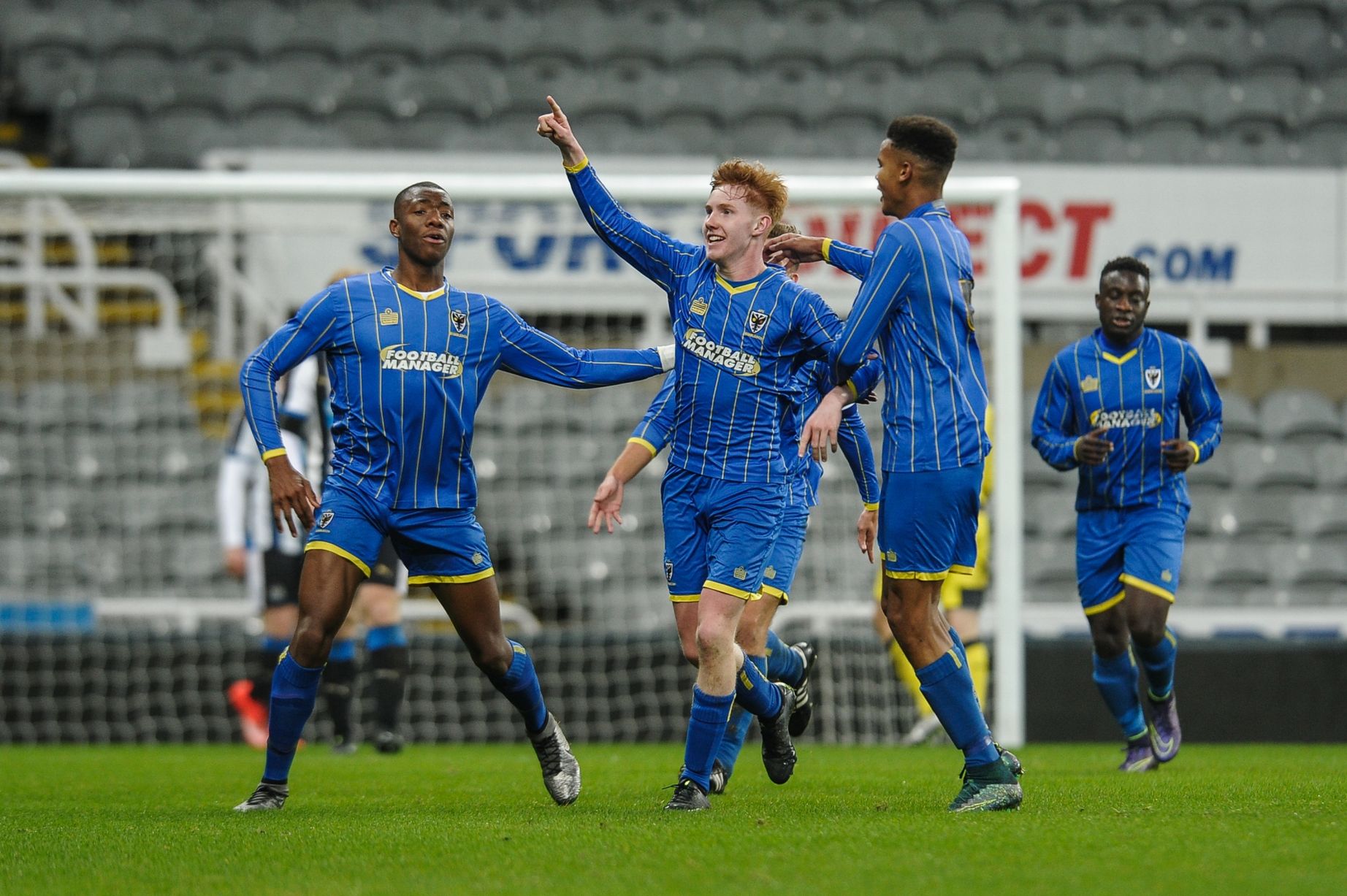
Nigel: Definitely the run when we beat Watford and Newcastle away and then the home game against Chelsea where 3k plus Wombles at Kingsmeadow gave the boys such rapturous support. That was the moment when the Academy staff felt that we had got the connection with the fans that we wanted and that the Academy could only go from strength to strength. All the doubters had been proved wrong, we could take boys off the parks and beat Premier League academies. I was also proud because I had been involved with so many of them. The Academy continues to over deliver. Winning the EFL U18 league trophy is just another source of pride as is seeing Academy boys as regulars in our first team.

Alfie Egan scores in the AFC Wimbledon Under18s win at Newcastle United

(x) The Academy have now formed the Nigel Higgs award to ensure your beliefs are recognised and upheld in the future, How does that make you feel?

Nigel: I am honoured to be recognised and it will be the highest achievement of my life to date. I also feel a responsibility to continue the ethos and values that have got us to where we are now and if I can play any further part, no matter how small, I will feel privileged.

(xi) You stepped away from the role in 2014. Why was that and did you leave with any regrets of things that may have been achieved?

Nigel: I had been flat out on this since we formed the football club and then in the preceding years I had to deal with several very demanding situations which had exhausted me. I had already taken two extended breaks from my business career to work for the club as we embedded the move to the EFL and EPPP cat 3 status and after starting my business in 2013 I could no longer afford the time or cost. With Jeremy Sauer stepping up to Academy Manager and Erik Samuelson  becoming more interested in the Academy we decided that my role could be subsumed between those two. No regrets. Just lessons.

Image
Will Nightingale celebrates a headed goal
Image
Jack ‘Rudi’ Rudoni unleashes a volley.
Image
Anthony Hartigan passing and set-piece general
Academy alumni Paul Osew smooth on the ball


(xii) Robbo has progressed from the youth set-up to first team head coach. As you look on at what he is now achieving and with home-grown players such as Will Nightingale, Anthony Hartigan, Jack Rudoni and Ayoub Assal playing significant roles, do you have a sense of fulfilment seeing all the groundwork now paying off and how the club’s squad is received by the community and fans?

Nigel: Definitely a sense of fulfilment, something I helped to create is now a large part of us successfully continuing the greatest story in English football. Plough Lane is fantastic and the family and community feel is everything we all hoped for back in 2002, and to have Academy boys becoming first-team regulars is brilliant and another part of the story; so yes proud as punch really 🙂

Image
Ayoub Assal chaired off by Ollie Palmer after stoppage time winner at Morecambe – PHOTO Lucy Dixon

(xiii) So what next for the club and its Academy? AFCW are a category 3 academy. What else would we need to do to become a category 2 and would it be worth it? What goals are out there still  to be attained?

Nigel: It would be great to move up to cat 2 because the games programme would be a higher level, but it would be hard to justify the extra expense. I haven’t researched current criteria but my recollection is that it is at least a further £500k costs plus capital investment in all-weather and covered training and education facilities. The football club needs to be considering medium and long-term plans for training at both first team and academy level but short-term we have more pressing costs to satisfy. In terms of other goals, we need to integrate and embed our youth development and recruitment approaches and to continue to innovate where feasible. Given our commitment to fan ownership and the implications on our playing budget we have to build out our data-driven recruitment strategy as a competitive advantage. This needs to be fully aligned between our own home grown and hungry players and the football market. The signs from our football transfer committee are that we are getting the right people in place to make that happen and I am excited about how that could develop. Finally, I have a few ideas that I want to implement that will recognise the contribution so many people have made to getting our Academy to where it is and further enhance our reputation of treating people well.

Joe Bursik now with Stoke City
Ryan Sweeney went to Stoke City, now with Dundee.


[The Nigel Higgs interview was first published in the October-November 2021 issue of the Wombles Downunder fanzine.  Details on how you can subscribe to Wombles Downunder.]



Robbo’s transformation of Wimbledon

0

MARK ROBINSON inherited a squad that had picked up two points from 11 games and was shot of confidence. In the remaining 21 games over 13 weeks he rebuilt a Dons team that would have comfortably finished mid-table if results were replicated over a full season. TIM HANSON’s analysis of the remarkable turnaround.

There were a few nervy moments – most notably the rollercoaster ride of the Rochdale match – but the Dons stayed up with a game to spare and can look forward to a sixth season of League One football.

Despite never really looking comfortable at League One level, this now means it will be the division when the Dons have spent the most time since 2002.

The Robbo transformation has certainly been impressive. Under his management, the Dons registered seven wins, eight draws and six defeats from 21 games. That works out at 1.4 points per game, which if replicated over a full season would add up to 64 points and a comfortable mid-table finish.

I think these numbers are particularly impressive in two respects. First, Robbo inherited a squad that had picked up two points from 11 games, was visibly shot of confidence and rated by many Dons fans as possibly the worst set of players to turn out for the club in several years.

To quickly have such a big impact with the same set of players deserves huge credit. And second, Robbo said himself when he took the job that he would not be a “quick fix” manager.

He has overseen 21 league matches in 13 weeks, with precious few full weeks between games to instil his ideas on the training pitch. That he has been able to have such a clear impact both on results and style of play, should also be highly commended.

So how has Robbo done it? I think the first thing to say is that he switched to a system that everyone was comfortable with.

Under Glyn Hodges, and before him Wally Downes, the Dons had almost always lined up in a 3-5-2 formation. This seemed to reflect a desire to have two strikers while remaining defensively solid, but the truth is that the Dons’ centre backs rarely looked comfortable in a back three.

Robbo has started with a back four in every game as manager and centre-backs who have previously struggled immediately looked more comfortable, Will Nightingale being the best example.

Over time, the rest of the formation has shifted to a 4-2-2-2 (see formation chart below), which suits the players all over the pitch. The Dons lack natural wingers but have attacking full backs that are allowed the space to get forward.

The holding midfielders – Alex Woodyard and George Dobson – can focus on their strengths of winning the ball back and starting attacks. The two ‘number 10s’ – Ayoub Assal and Jack Rudoni – are given freedom to roam and create. And Joe Pigott and Ollie Palmer both benefit from having another forward to play with.


With Pigott and Palmer supported by Assal and Rudoni, the Dons started to pose an attacking threat they had previously lacked. In addition, while Robbo has retained a focus on keeping possession throughout his time in charge, the Dons have increasingly got the ball forward a bit more quickly, rather than keeping passive possession in more defensive areas.

This is borne out by the possession stats: in the 13 games under Robbo prior to switching to a front two versus Accrington, the Dons averaged 53% possession; in the (more productive) eight games since, it has been 45%.

The Dons have still tried to keep the ball far more than was the case under Hodges (when average possession was around 40%) but it now carries more of an attacking threat.

Mark Robinson and Ayoub Assal

Given Robbo’s background, it is perhaps unsurprising that he has been keen to put more faith in the talented young players at the club and this too has had a big impact.

Most notable has been the emergence of Assal, who only started his first league game on  March 20 and has quickly become a spearhead of the Dons’ attacking threat. It’s excellent news that he has signed a new three-year contract.

Rudoni has started most games under Robbo and now has more of a goal threat to supplant his creativity.

Robbo was also happy to put his faith in Nik Tzanev to take the gloves when Sam Walker was out injured, which has paid off handsomely.

Football fans in general, and Wimbledon fans especially, love nothing more than seeing their own home-grown players turn out for the side, and there should be much more of this to come next season and beyond.

It should also be acknowledged that more experienced players have improved under Robbo, backing up his belief that player improvement and development does not end with the academy.

Alex Woodyard

Woodyard is perhaps the best example in this regard, looking a hugely underwhelming signing for large parts of the season, transformed into a vital part of the Dons’ midfield under Robbo.

It will be interesting to see how Robbo shapes the squad over the summer, but already it’s clear that there should be less turnover than in previous seasons. Only three players have so far been released – O’Neill, Reilly, and McLoughlin – with 21 players already contracted for next season. That 21 includes a number of players who will probably not be considered first team ready and instead go out on loan, so reinforcements will be needed.

It is hoped that Joe Pigott will sign a new deal and remain at the club, though given his form over the past season it’s likely other clubs will be interested.

Pigott’s 20 league goals and five assists meant he scored or assisted 46% of the Dons’ goals, the highest individual contribution to a team’s goals anywhere in League One.

Joe Pigott

He will be a very hard man to replace if he does go. Other priority areas for the summer recruitment include an energetic central midfielder (Dobson would be ideal), another forward option, another full-back, a back-up keeper (assuming Matthew Cox goes out on loan), and ideally some more pace at centre-back (though there are good numbers there already).

I’m sure Robbo will also give some thought over the summer to continue to evolve the style of play and produce other tactical options.

One challenge next season will be facing opponents who know more about how a Mark Robinson Wimbledon team wants to play, and so be better placed to capitalise on any potential weaknesses.

There were already signs of this in the closing games of the season, where Rochdale and Portsmouth regularly got in behind the Dons’ defence with quick forwards. Robbo likes to play a high defensive line but with relatively slow centre backs and attacking full backs, it can allow space for opponents to attack.

In this regard, it’s encouraging that Robbo recently said that ‘formation flexibility’ is a key area for improvement, so the Dons can present opponents with new and expected problems during games.

It feels like an exciting time to be a Wimbledon fan, with much hope for what a Robbo-led team will deliver next season, alongside the prospect of full crowds at Plough Lane.

The recent test event, which I was lucky enough to attend, gave 2,000 fans their first glimpse of the new stadium, and it was certainly impressive.

Thoughts quickly turned to just how good it will be for a competitive game with a (hopefully) full crowd next season. I, for one, can’t wait to find out!


It’s been a long time coming, but it’s All Together Now

0


ERIK SAMUELSON has been closely involved in one of football’s greatest stories: AFC Wimbledon. He spent 18 months researching, interviewing and writing ‘All Together Now’ and gives a taste of what was involved in the massive project.


(i) What were your thoughts behind writing ‘All Together Now, The Extraordinary Story of AFC Wimbledon’? How much time has gone into research, interviewing and writing the book?

Erik: I’m not sure exactly what triggered my decision to write this book.  It went from being a vague idea to something I’d talked about so much I felt I had to do it.  It was also to give me a project in retirement, which proved to be a very lucky decision because it gave me a focus during lockdown.  And everyone says it’s a great story, so it needed telling. I didn’t want to work to someone else’s timescale and I wanted to avoid it being an ‘as told to’ book; with very few exceptions, those don’t work for me.  So I decided to write it myself.  And being involved so closely from the beginning gave me unique insights which I thought might interest people.  I wrote it as the narrator of the story.  Obviously I appear in it from time to time, but the book is about the club, not me. 

(ii) Give a sense of what went into writing the book, the number of interviews, photos sourced, library visits, watching old DVDs and YouTube. etc.? Was there an interview or interviews that were particularly difficult to pin down and was there material you wanted to get into the book but were unable to fit in?

Erik: I’d never written anything much longer than a programme page but the process seemed obvious. After all, I was writing a story that already existed; I didn’t need to invent a plot, characters and locations.  So out came the spreadsheet. In column A I listed the chapter headings. Column B was each chapter’s key events, Columns C, D etc. listed the key people.  After ticking which people were central to which events I had a rough interview structure. Then came the reading material: all the news items and match reports on the heritage web site; DT board minutes and papers; thousands of my own emails and documents; the South London Press from Battersea Library; raiding the Non League Paper archives; googling key events; re-reading various agreements, contracts and letters.  Plus the visual media; Womble Til I Die dvd; Football Hurts; the first ten years’ highlights compilation; YouTube highlights; the club site itself; and photos from numerous sources.  Finally, the interviews. Only a small number of people chose not to be interviewed; most people were amazingly accessible, open and frank. I was so daunted by the research list that I thought I’d interview someone and see how it went.  It was also a way of forcing myself to write it – once I’d taken up people’s time to talk to me I felt I had no choice other than to get on with it… My first interview was David Fowkes of the London FA on 4 October 2019, about six months after I retired.  He guided the founders through setting up the club. Over the following seventeen months I interviewed 80 people, some multiple times, so I ended up with 96 tapes, comprising 117 hours and 36 minutes of recorded material (the obsessive accountant in me just had to add them up…)  That is nearly five solid days of interview time.  Transcription took at least 2 – 3 times as long until Clare Richardson kindly offered to help, although by then I’d done over 70 of them myself. I wrote about five chapters ahead of my interview and reading schedule.  Towards the end I looked at various books as a check that I’d missed nothing out.  ‘This Is Our Time’ was a particularly valuable resource and I also dived into Herbie Knott’s unpublished record of our first season.  I’ve no idea how proper authors go about things but this worked for me. Was there material I wanted to include but couldn’t?  Yes, lots.  I was advised not to include some material because it would breach legal agreements and I left out some stories that would have damaged the club.  To include everything would have needed a substantial expansion of an already long book, so some stuff didn’t make the cut.  

Over 17 months I interviewed 80 people, some multiple times, so I ended up with 96 tapes, comprising 117 hours and 36 minutes of recorded material

(iii) Along the way what were the things that surprised you (even in your privileged insider position as the former CEO of the club). Any parts that gave you particular joy (or perhaps disappointment) to uncover and include in the book?

Erik: The conversations were a joy.  I call them conversations because allowing the interview to ramble within a broad structure unearthed a host of material I don’t think I’d have obtained by other means.  A couple of people asked to be interviewed by email but I refused; I needed to be able to pursue anything that caught my attention. I didn’t learn anything significant, but there were some great anecdotes which were new to me.  The biggest surprise was that some people couldn’t recall anything at all about what I thought were major events in the club and, I assumed, their lives.  However, they weren’t alone; one interviewee talked about a big row at a DT board meeting.  I had no recollection of it at all.  I’ve checked – it did happen and I was part of it, but I still can’t remember it.  I became very aware of how memory changes and distorts things.  An article in the New Scientist really struck home when it said that the more often you tell a story the less accurate it gets.  The logic is simple – at every telling you add a little bit, or forget a detail, or simply embellish it. Then that version forms the basis of the next time you tell it, when it changes some more.  An example of this was when I asked Seb Brown about ‘that piece of paper’ he was looking at during the shoot out in Manchester.  Seb told me it contained five players’ names but only two of them were still on the pitch.  So I reminded him that in ‘This Is Our Time’, he said it was four names with only one still on the pitch. He couldn’t believe he’d remembered wrongly so he dug out the paper from his dad’s loft. It was four and one, but frequent telling had changed it. It was an entirely innocent example of the vagaries of memory.  And I’ve now got a photo of the list to disprove some fans’ theory that it was blank. All this went to reinforce my view that people will tell me that I’ve got lots of things wrong.  All I can say is that whenever possible I’ve compared people’s recollections to documents that were written at the time.  If there was no independent evidence then I’ve taken the version that sounded most likely.  I’d welcome anyone pointing out mistakes, so long as they understand that their memory is probably as imperfect as mine!

I’d welcome anyone pointing out mistakes, so long as they understand that their memory is probably as imperfect as mine!

(iv) Did you have a favourite interview or interviews during your research, any particular anecdotes/scenarios you can share?

Erik: Trevor Williams and Dave Anderson were particular fun.  Pre-lockdown, Dave came to my house for our chats and Eileen said that all she could hear was non-stop laughter. Trevor is also very funny and his passion always comes across.  Plus he has great stories from having been in the dressing room throughout the years.  I enjoyed Alan Bennett telling me how Simon Bassey lured him into joining us, Jon Main explaining how he nearly owned an Aston Martin, and Stuart Douglas’s pact with Andy Barcham.  I was told early on not to expect to make any money out of the book, but I’d prefer that you read the anecdotes in context, not here.  (If I do make any profit I will give a percentage to the Foundation.) But here’s one brief story which reminded me how little decisions can affect history.  I interviewed Gary Brabin, the Luton manager.  He told me that when they were practising penalties, Jason Walker took a Panenka-style penalty, exactly like the one that Seb saved.  Walker’s teammates gave him such a hammering for not smashing it that Gary decided he didn’t need to reinforce the message.  I’m very glad he didn’t…

(v) So throughout the 400-plus pages of the book what stood out for you over all these years at the helm of AFC Wimbledon’s remarkable rise from the Combined Counties League days?

Erik: I reluctantly signed up for a film about the club and I was relieved when it didn’t get made. A film requires a hero and that would distort what happened. In the real world, new heroes emerged when they were needed and then quietly stood back when their bit was done.  That’s largely why the book has its title. What stood out as I wrote the book was the sheer number of people who contributed to what we achieved and the massive range of talents and energy they brought to our success.  I hope I’ve managed to bring that out, rather than only lauding a small number of individuals, important as they were.  I will have forgotten some people – I can only apologise to anyone I’ve inadvertently overlooked.

That’s largely why the book has its title. What stood out as I wrote the book was the sheer number of people who contributed to what we achieved and the massive range of talents and energy they brought to our success.  I hope I’ve managed to bring that out.

(vi) Is that the end of your writing days, given the enormous amount of time it has taken you to get it to print or has it developed an urge to write some more, perhaps on another topic?

Erik: I don’t know.  I’m not an author and I don’t want to be.  This subject was something about which I had a unique insight, having been at the centre of things for so long.  I can’t think of another topic for which I’d have the drive to dedicate another year and a half of my time. I’d like to get a balance back in my life and do some different things – like a trip to the Ashes in December, lockdowns permitting!

As to the scale of the achievement, I think what we did together is quite extraordinary.  Every non-Wimbledon football fan I meet thinks ours is a great story.

(vii) To everyone’s great disappointment fans have been unable to get inside Plough Lane and watch the Dons matches. Has the new ground lived up to your hopes, dreams and expectations from those early planning days? What scale of achievement has AFC Wimbledon and its fans pulled off in getting back to Plough Lane?

Erik: For me the idea of having a new stadium was always more important than what it looked like.  I went to the first game and there were quite strict rules about where we could and couldn’t go.  So I’ve not really seen it properly but the important thing is that it is there and it is ours.  My only disappointment, and it is a major one, was that there were no fans there.  I want the place full, with fans raising the roof.  As to the scale of the achievement, I think what we did together is quite extraordinary.  Every non-Wimbledon football fan I meet thinks ours is a great story.  To end where I started this interview, that’s one of the reasons I felt I just had to write the book.  I hope I’ve done everyone justice.


‘All Together Now, The Extraordinary Story of AFC Wimbledon’?  Published by Pitch Publishing, will be on sale in May, the hardback price is £19.99.